



Case Study
User Experience Research on Event Registration Processes to Enhance Lead Generation at StellarGens
Project Scope
User Experience Research
Company (Dummy)
StellarGens
Business Field
Edutech
Phase 1: Introduction

This segment focuses on gaining a deep understanding of the problems and needs to be addressed, while clearly defining the research direction and boundaries.
A.
Company Profile
StellarGens (PT Aksara Stellar Generations) is a Jakarta-based edutech and outsourcing startup focused on professional capability development. Its flagship services include training, certification, and human resource solutions. Through innovative strategies, StellarGens empowers organizations and individuals to remain relevant amidst dynamic digital transformations across various industrial sectors.
B.
Business Case
The National AI Talent Development Program is a B2B2C collaboration between Alibaba Cloud and StellarGens, aimed at increasing brand awareness and generating AI product leads. By utilizing the Event feature on StellarGens' website as a centralized registration platform, participant conversion across five major cities serves as a critical metric for program success and ROI for all collaborators.
C.
Problem Statement
The Jakarta chapter is showing critical performance gaps due to poor ticket sales during the initial 7-day period. This shortfall threatens the target of 500 valid participants and risks the program's overall sustainability. Early indicators point to significant bottlenecks in the StellarGens Event conversion funnel, which are severely obstructing registration.
D.
Research Objective
This user experience research is an urgent priority to empirically identify the root UX issues. The case study results from the Jakarta chapter will serve as a database to:
1.
Identifying user pain points, friction, and journey misunderstandings within the conversion funnel.
2.
Formulating actionable strategic recommendations for decision-making.
The final objective is to optimize the Jakarta chapter's conversion funnel and apply these critical interventions prior to the events in Bandung, Yogyakarta, Surabaya, and Makassar.
E.
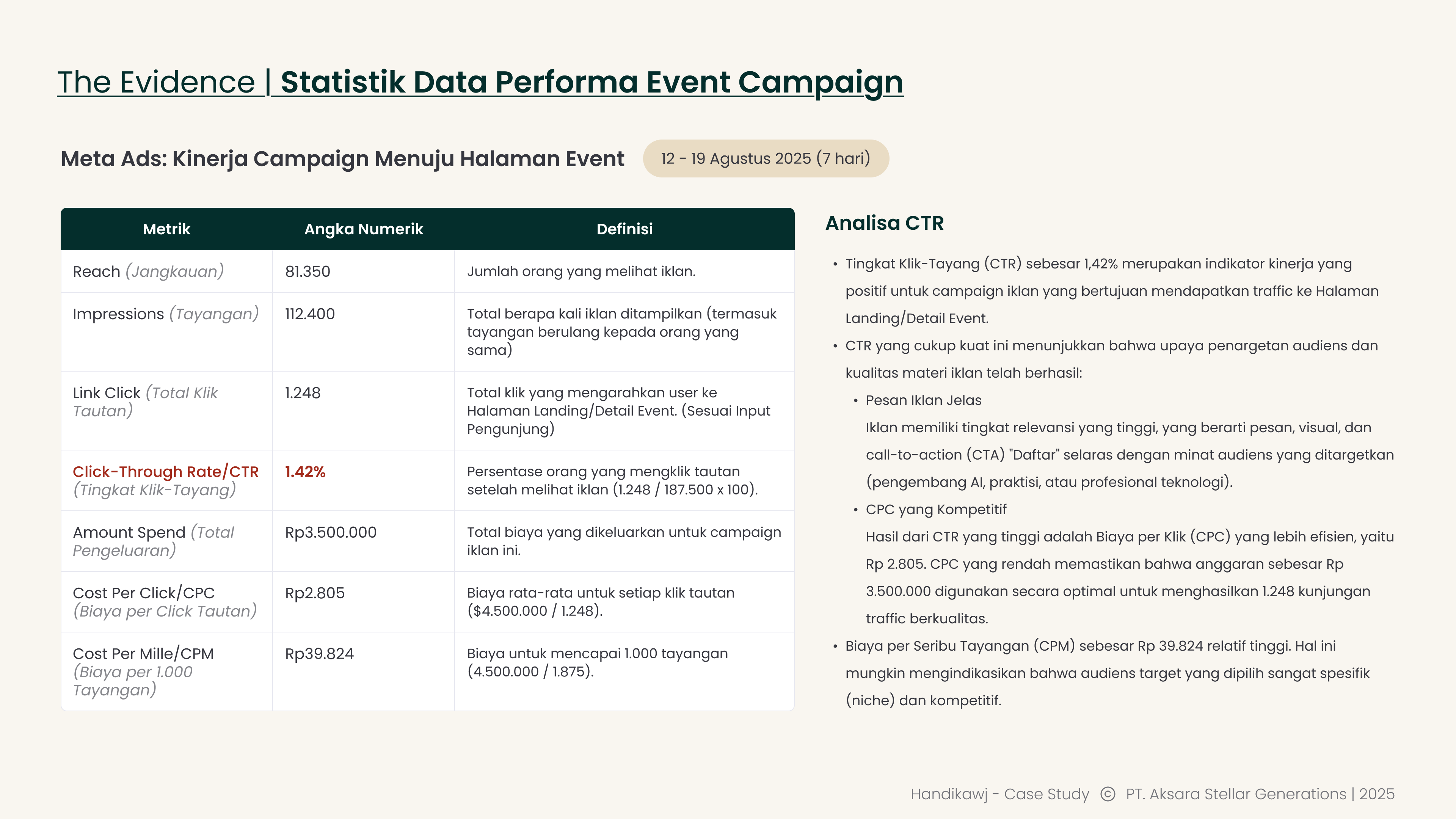
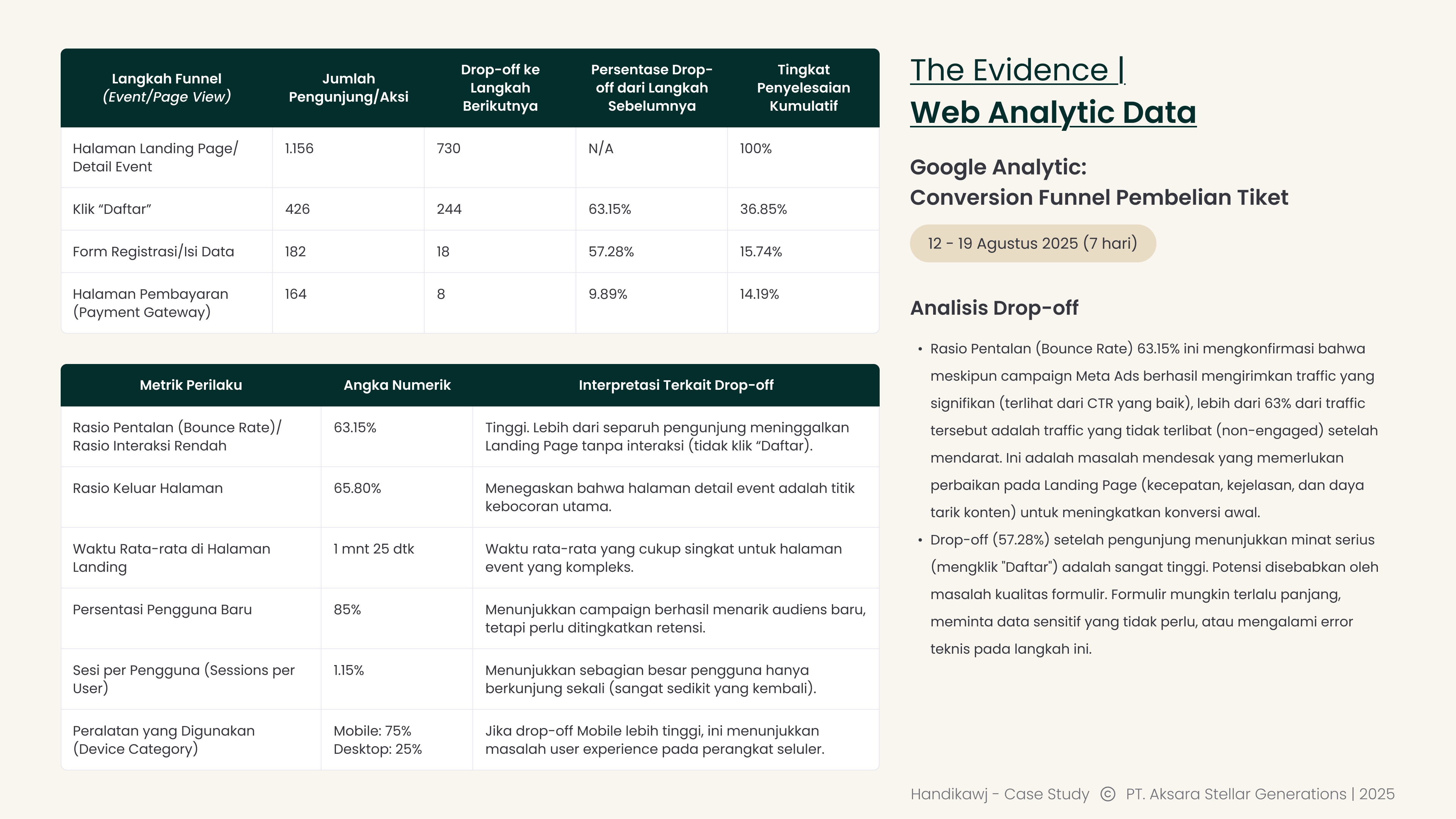
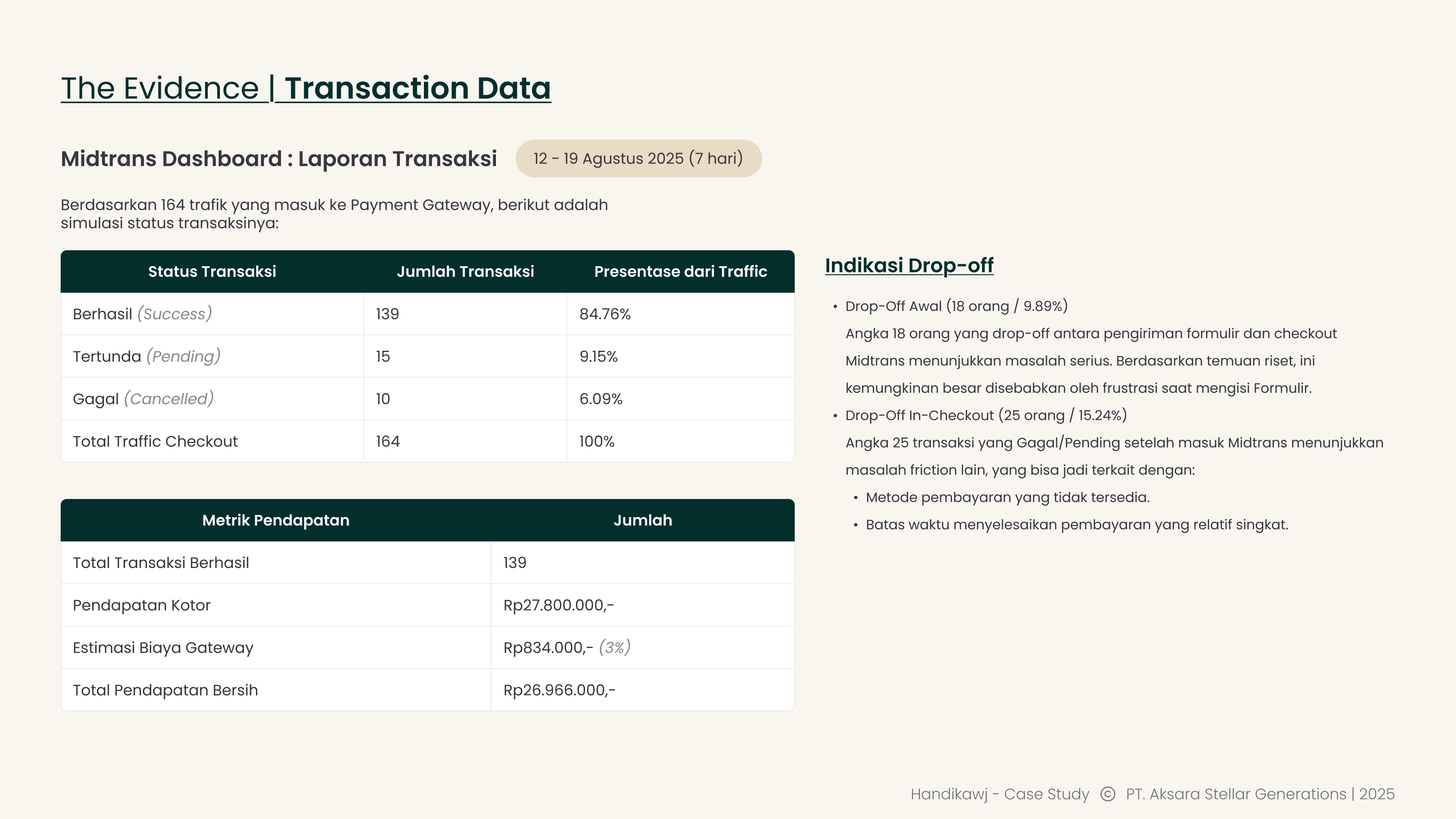
The Evidence
Presents a data recap and analysis as authentic evidence to validate the core issues. Its function is to ensure that root causes are accurately identified based on facts, providing the research design with a solid argumentative foundation rather than relying on mere speculation.
F.
Hypothesis
Primary Hypothesis (H1): Conversion Failure
The low conversion rate of StellarGens' Event feature is driven by poor User Experience (UX) and usability, particularly due to critical barriers within the registration conversion funnel.
Specific Hypothesis (H2): Registration Form Barriers
The current design and complexity of the registration form impose a high cognitive load on users, resulting in significant drop-offs before completion.
Specific Hypothesis (H3): Time Pressure & Payment Reminders
The short payment window (2 hours) and suboptimal reminder messages trigger high customer drop-offs before transaction completion.
Phase 2: Research Design
This segment focuses on the research planning and execution process, serving as a framework for data collection and analysis.
A.
Research Methods
A comprehensive overview of the framework and methodology used to collect data, ensure accurate findings, and objectively validate user needs.
Research Methods
Qualitative Research
This approach aims to gather deep insights into the user experience when interacting directly with the event program's conversion flow.
Data Collection Technique
In-Depth Interviews
Contextual interviews were conducted based on the user experience.
B.
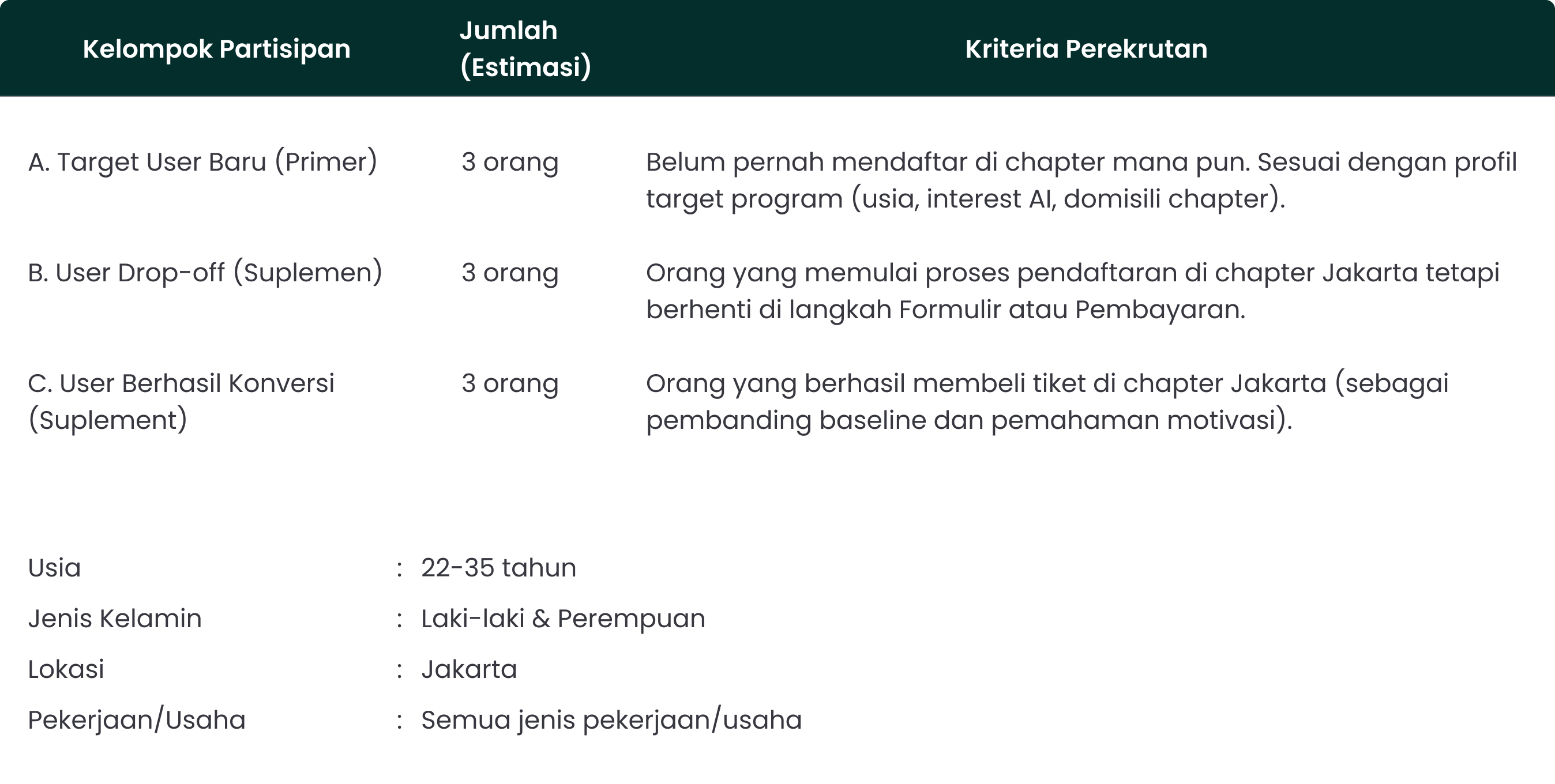
Population & Sample
Defining target user profiles and participant criteria to ensure that the collected data remains relevant to the product ecosystem.
C.
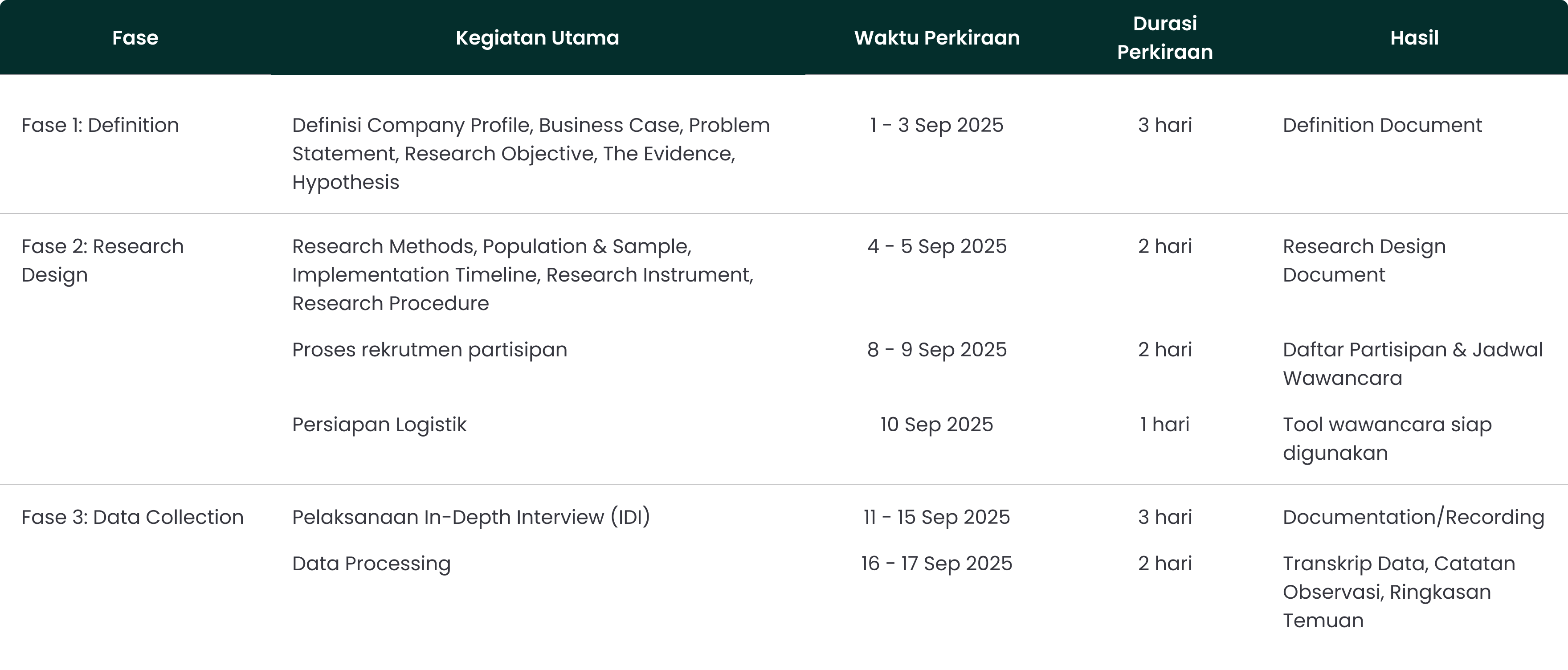
Implementation Timeline
A detailed work plan mapping out every research phase, from preparation to final reporting, to ensure the project stays on schedule.
D.
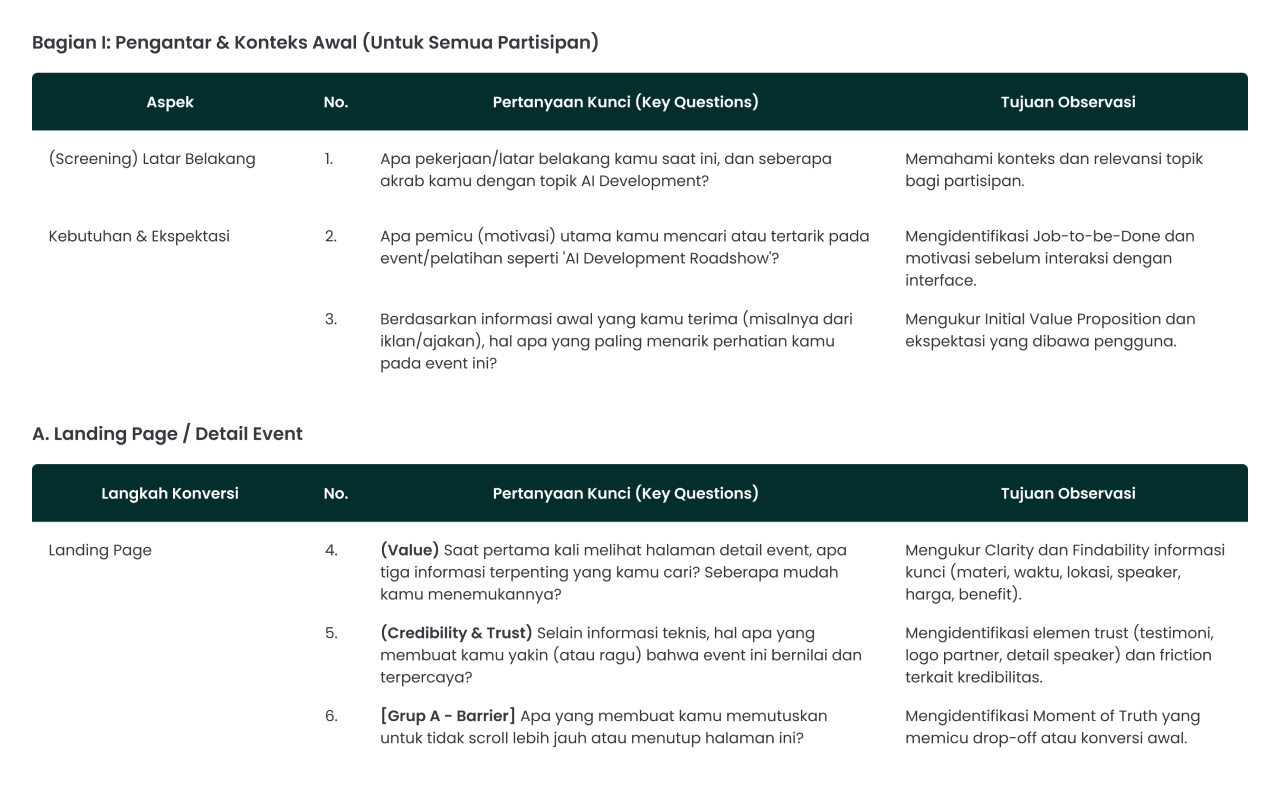
Research Instrument
A list of tools and structured guides used for consistent data collection, ensuring that every participant interaction yields valid and measurable information.
E.
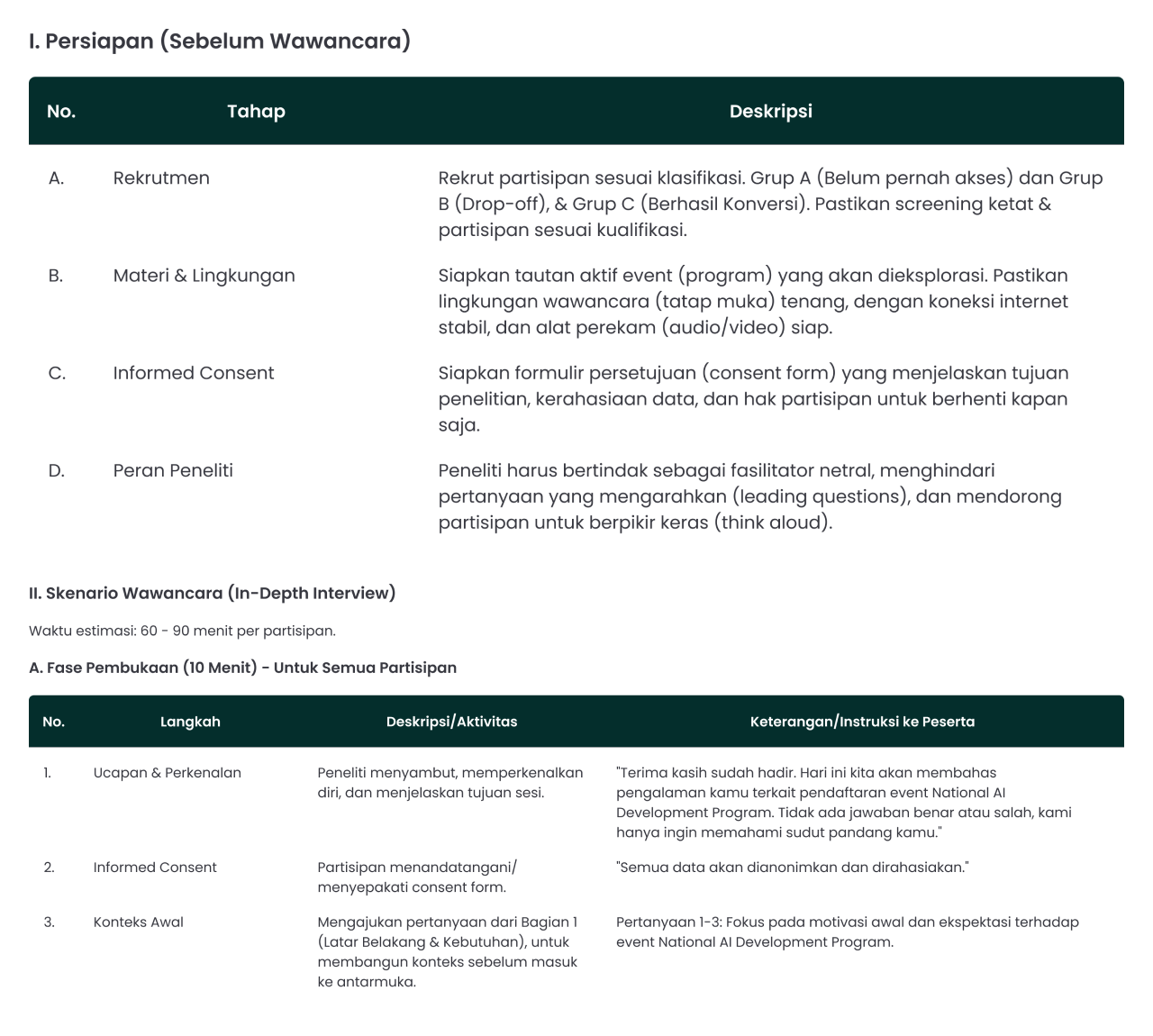
Research Procedure
A series of systematic steps conducted in sequence, from preparation to data processing, to ensure integrity and consistency throughout the research process.
Phase 3: Data Collection
This segment focuses on the implementation of the research design to acquire and collect data.
A.
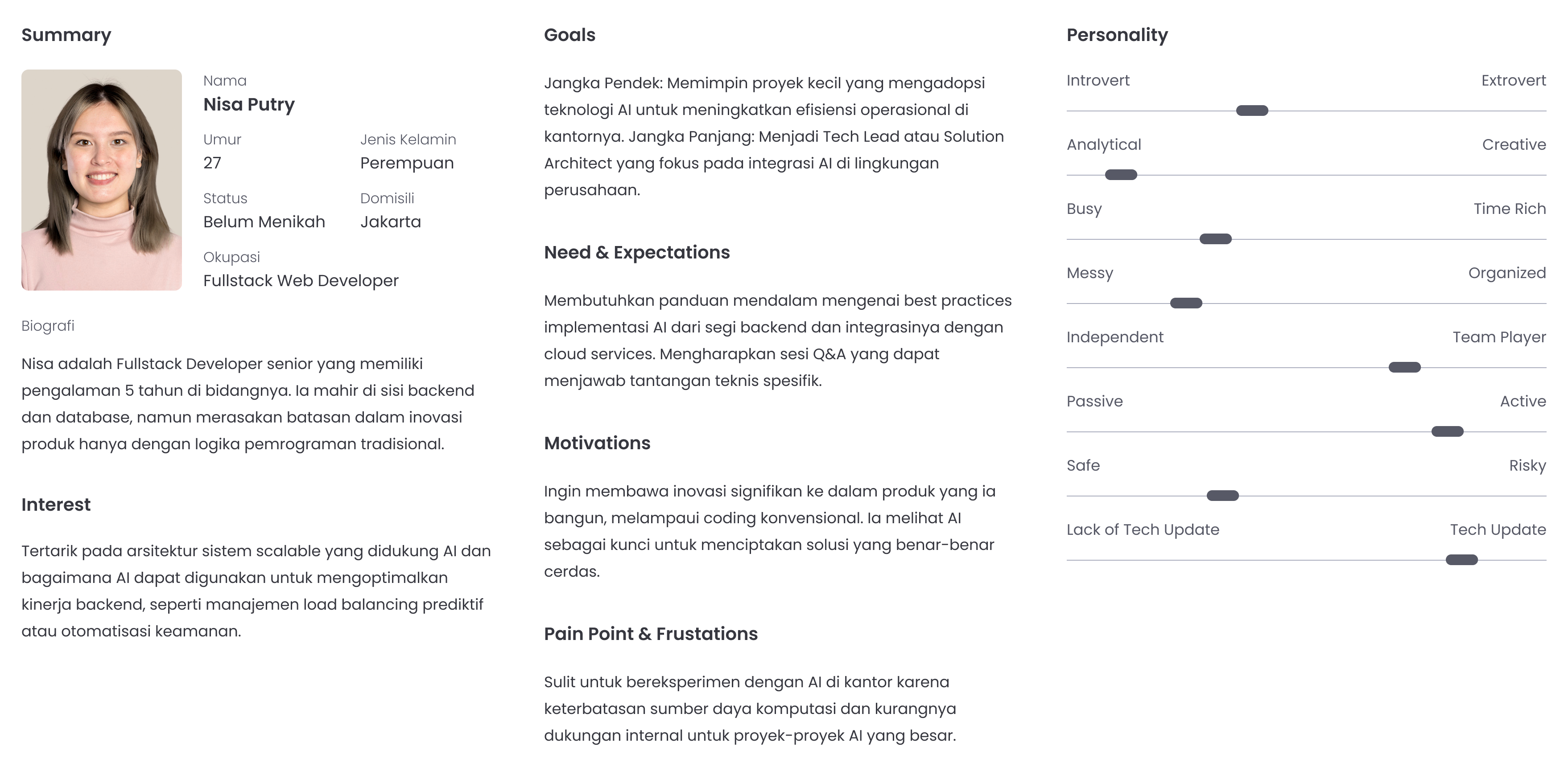
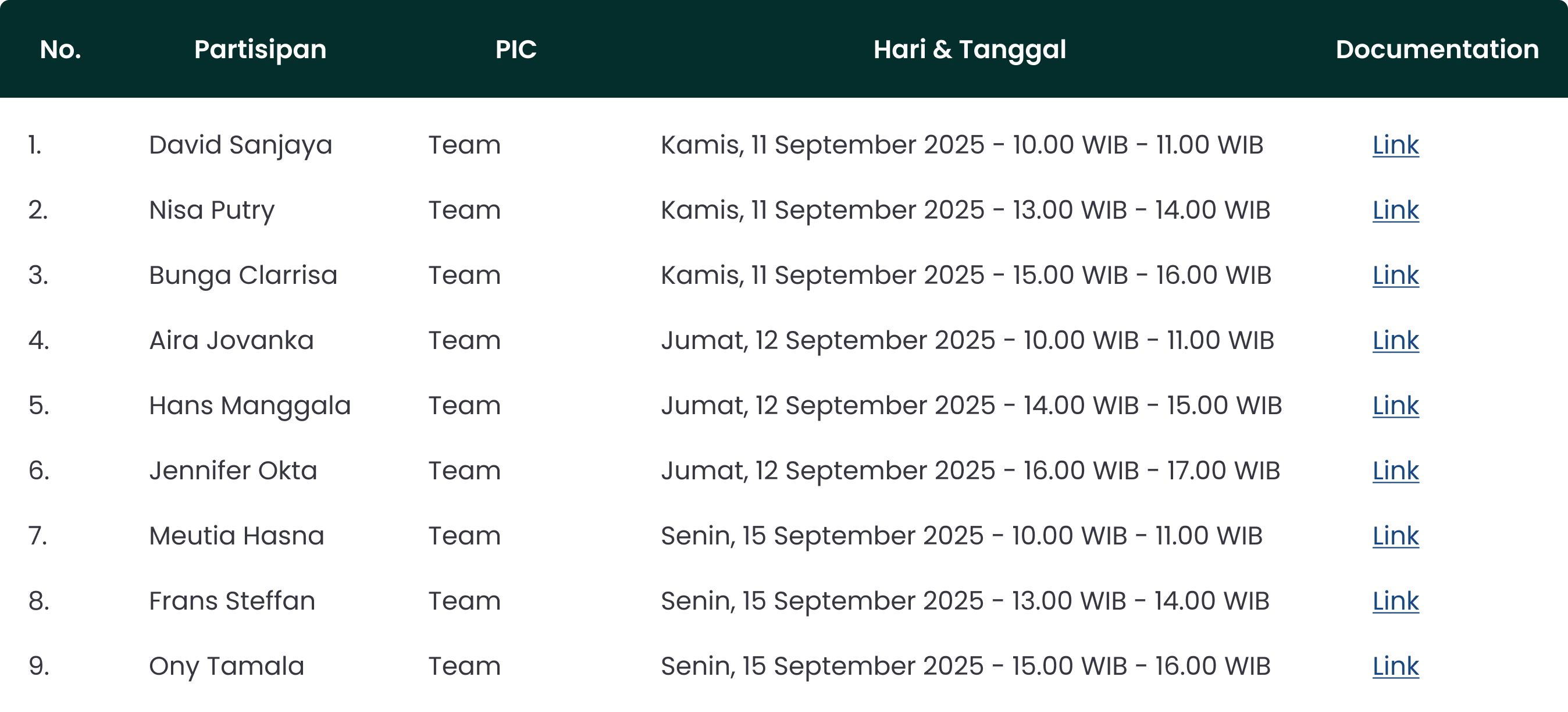
Participants & Research Schedule
A brief participant profile and a summary of the research session schedule to ensure efficient data collection.
B.
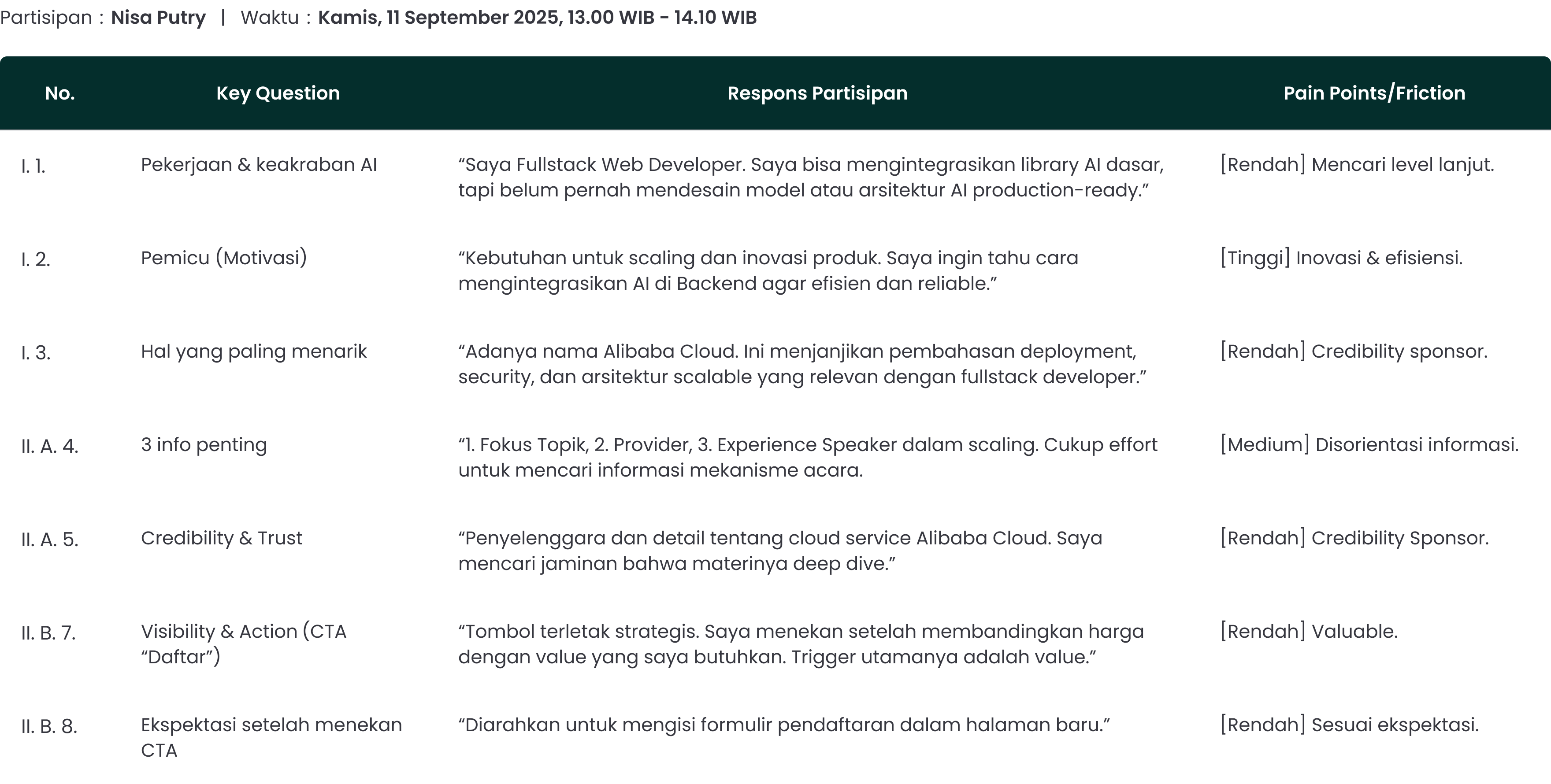
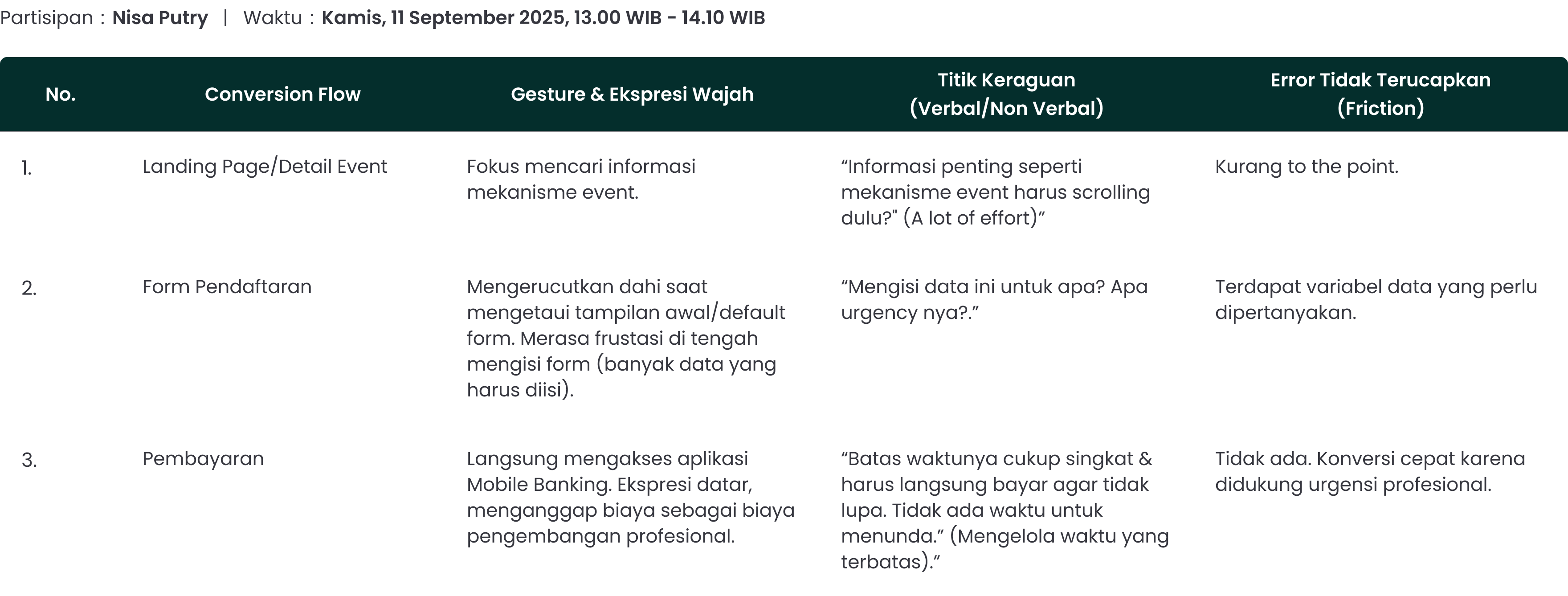
Data Transcription & Observation
The process of documenting every participant interaction verbatim and noting non-verbal behaviors to ensure the entire research context is captured objectively.
Phase 4: Data Analysis & Synthesis
This segment focuses on the systematic process of transforming raw data into meaningful information and verifiable insights.
A.
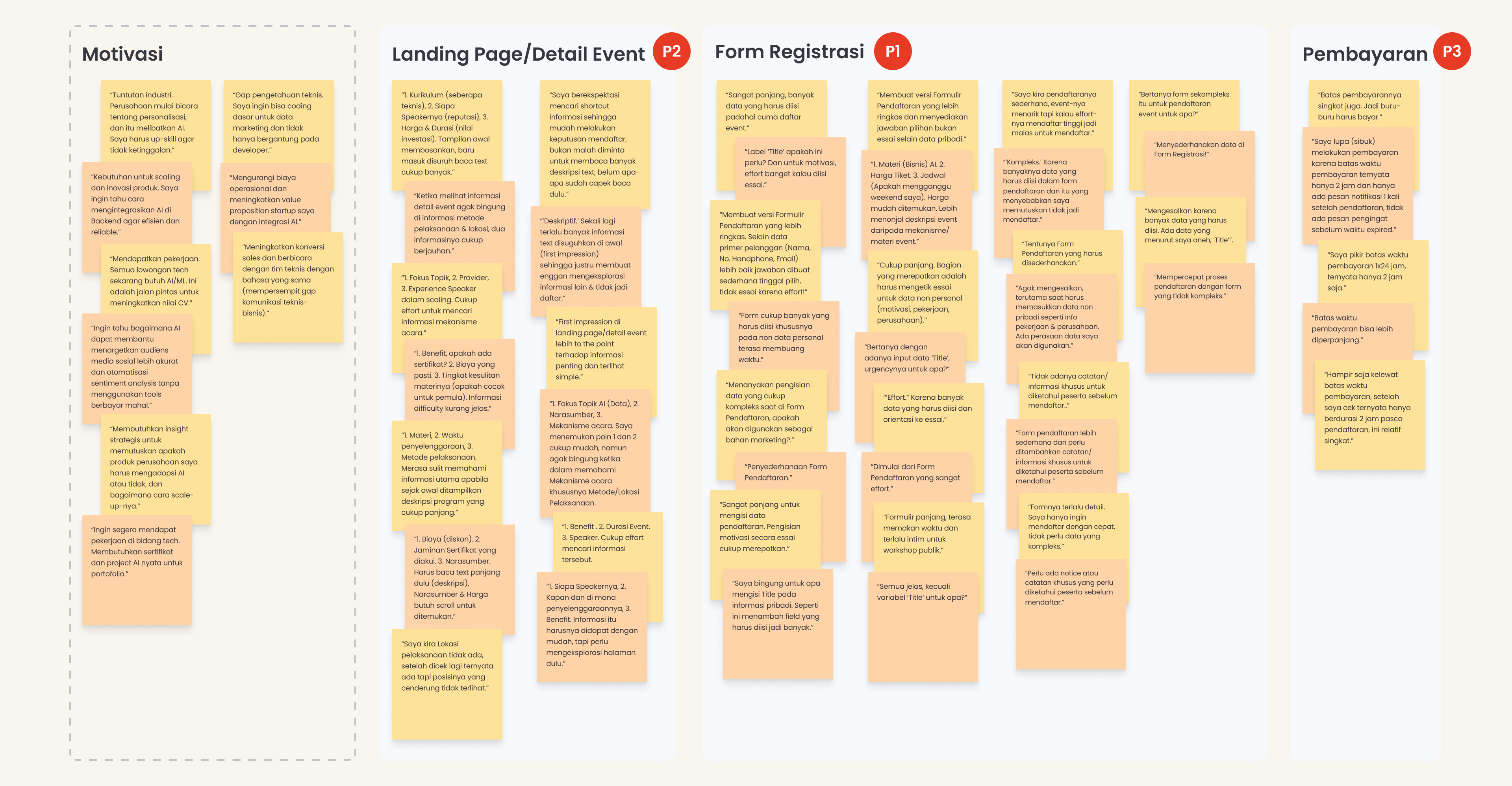
Affinity Diagram
Process of grouping research findings to identify recurring patterns, key themes, and the interconnections between user pain points.
B.
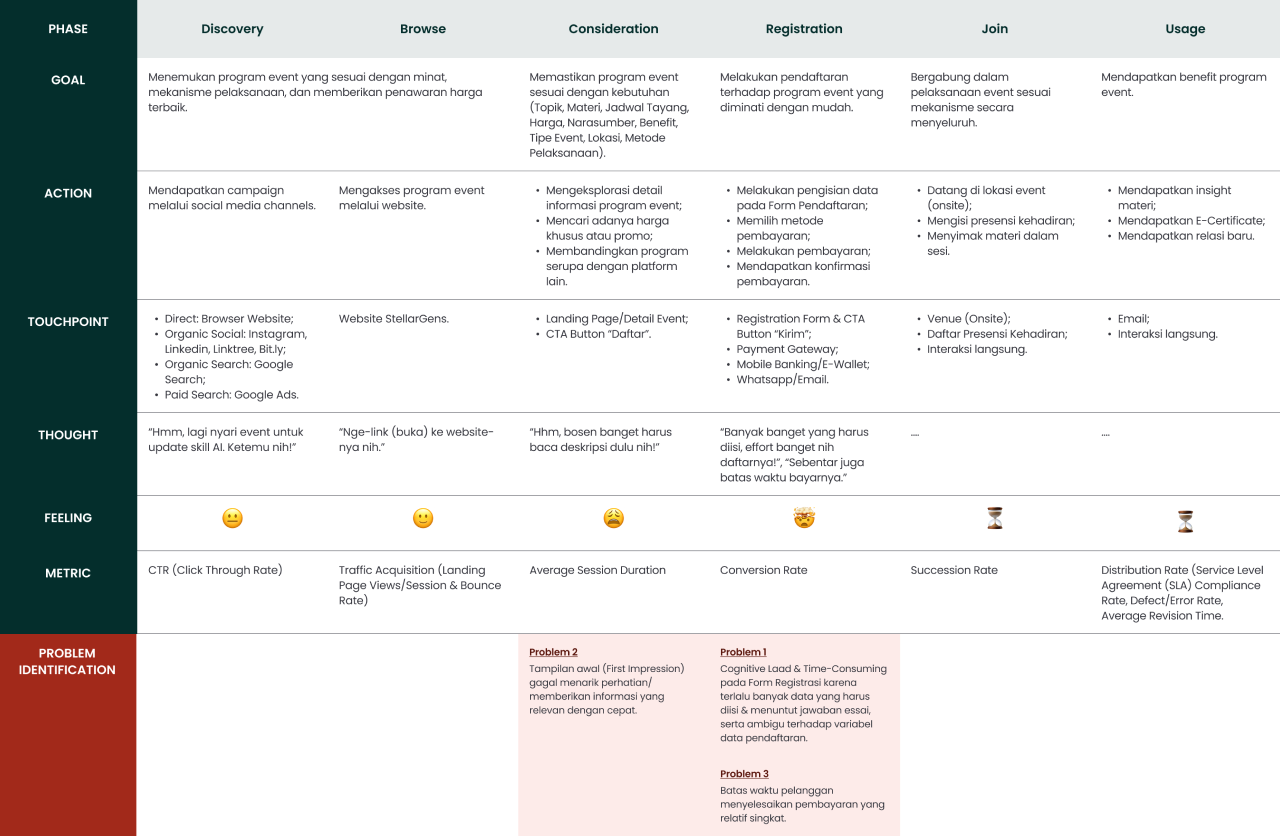
Problem Identification
Transforming information clusters into identified user pain points, ensuring that the design focus is directed toward the most impactful user barriers.
C.
Analysis (Critical Findings) & Synthesis
Research findings reveal a fatal misalignment between the effort required from users and the value provided by the product, with friction emerging at every crucial phase of the user journey.
Problem 1
High Cognitive Load and Time-Consuming Registration Process
The issue with the registration form isn't just the number of fields, but the requirement for essay-style answers. Psychologically, this forces users to shift from Fast Thinking to Heavy Thinking mode.
Synthesis
Users experience fatigue before completing the registration within the conversion flow. We are losing user motivation and momentum right at the entry point due to a process that feels heavy cognitive load.
Problem 2
Expectation Mismatch on First Impression
The failure of the initial interface indicates a clear relevance gap. Users arrive motivated to grasp information as quickly as possible, yet the program greets them with text-heavy, generic, or poorly directed content.
Synthesis
There is a disconnect between the marketing promise, the moment they decide to click and the product reality. If the first 5–10 seconds fail to validate user needs, they subconsciously conclude that the product is not for me.
Problem 3
Support Deficit during the Transactional Phase
Short payment windows without effective reminders create unnecessary stress points and increase the risk of human error.
Synthesis
We erroneously assume users have undivided attention, when in reality, they face constant real world distractions. Failing at this stage is particularly costly because it occurs among high intent users. We are not losing them due to a lack of interest, but because our system is not tolerant enough of human error (forgetfulness/distraction)

Extracting critical findings, transforming raw observations into deep strategic insights on user behavior and expectations.
Phase 5: Conclusion & Recommendation
This segment focuses on the research conclusions and the strategic recommendations provided to the relevant departments.
A.
Conclusion (Key Insights)
Based on the preceding synthesis, the following are the strategic conclusions for product improvement:
Insight 1
Complexity is a Barrier to Conversion
Our current registration structure is too data heavy. To enhance user retention, we must pivot toward a relationship first approach.
Insight 2
First impression is an instant touchpoint for understanding the program.
The initial interface must stop being a static brochure and start being a dynamic solution. Information clarity must be prioritized over mere aesthetics to minimize bounce rates.
Insight 3
From Urgency to Empathy
Transform rigid billing into a reminder assistant. Utilize push notifications and flexible scheduling to recover pending conversions. This strategy pivots from applying pressure to providing support.
Executive summary distilling the essence of the user experience to provide direct answers to the research questions and define the strategic roadmap for future product development.
B.
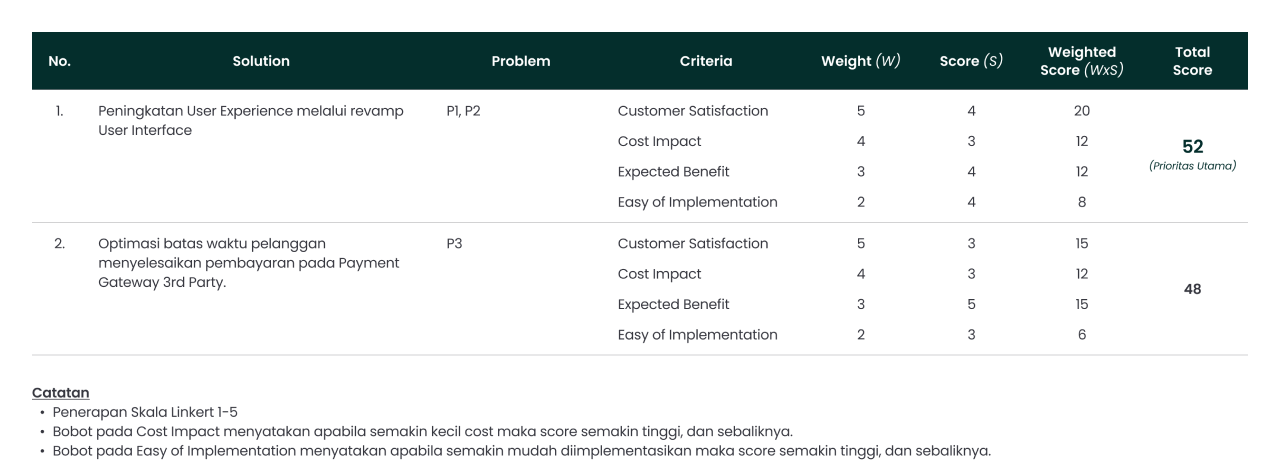
Solution Selection Matrix
An evaluation framework used to prioritize solutions based on the balance between user value and technical feasibility, ensuring resources are allocated to the most impactful features.
C.
Strategic Decision Recommendations
Top Priority: Enhancing User Experience through a Strategic User Interface Revamp.
To address the conversion challenges, the immediate priority is to enhance User Experience through a UI revamp, focusing on two crucial elements:
Landing Page/Detail Event
Goal :
Capturing attention within the first 5-10 seconds to convey core value, while providing structured and persuasive information.Revamp Focus:
Dominant placement of critical information, paired with high-quality visuals that are deeply relevant to the market segment.
Registration From
Goal :
Reducing user burden and streamlining processes (Cognitive Load & Time-Consuming), while maximizing completion rates.Revamp Focus :
Validation and optimization of mandatory data inputs.
Tactical recommendations designed to mitigate user barriers and maximize market opportunities, ensuring every design decision is grounded in valid and measurable data.

Takeaways
Through this case study, I have gained a deep understanding that successful product development is about more than just aesthetics; it is about solving real world problems. Below are my key learning points:
Empathy as a Design Compass
This research proves that personal assumptions often differ from the reality on the ground. Listening to the users voices and understanding their behaviors firsthand helped me set aside my biases and focus on truly essential needs.
Data Eliminates Ambiguity
The transcription and observation process turned doubt into certainty. With solid data, every design decision is backed by strong reasoning (evidence-based design), making communication with stakeholders much smoother.
The Importance of Structured Synthesis
Through the Affinity Mapping process, I learned that a collection of random data can be transformed into a powerful narrative. Grouping these issues helped me identify big-picture patterns that were not visible at first glance.
Prioritization is the Key to Efficiency
Through the Solution Selection Matrix, I understood that not all problems need to be solved at once. Balancing User Value against Business Effort is a crucial skill for any designer.
Design is an Iterative Process
This research is not the end, but rather the beginning of a cycle of improvement. The Strategic Decision Recommendations ensure that the product continues to evolve in line with changing user behaviors and expectations.

Handikawj - Product & UI/UX Designer | 2026
Case Study
User Experience Research on Event Registration Processes to Enhance Lead Generation at StellarGens
Project Scope
User Experience Research
Company (Dummy)
StellarGens
Business Field
Edutech
Phase 1: Introduction
This segment focuses on gaining a deep understanding of the problems and needs to be addressed, while clearly defining the research direction and boundaries.
A.
Company Profile
StellarGens (PT Aksara Stellar Generations) is a Jakarta-based edutech and outsourcing startup focused on professional capability development. Its flagship services include training, certification, and human resource solutions. Through innovative strategies, StellarGens empowers organizations and individuals to remain relevant amidst dynamic digital transformations across various industrial sectors.
B.
Business Case
The National AI Talent Development Program is a B2B2C collaboration between Alibaba Cloud and StellarGens, aimed at increasing brand awareness and generating AI product leads. By utilizing the Event feature on StellarGens' website as a centralized registration platform, participant conversion across five major cities serves as a critical metric for program success and ROI for all collaborators.
C.
Problem Statement
The Jakarta chapter is showing critical performance gaps due to poor ticket sales during the initial 7-day period. This shortfall threatens the target of 500 valid participants and risks the program's overall sustainability. Early indicators point to significant bottlenecks in the StellarGens Event conversion funnel, which are severely obstructing registration.
D.
Research Objective
This user experience research is an urgent priority to empirically identify the root UX issues. The case study results from the Jakarta chapter will serve as a database to:
1.
Identifying user pain points, friction, and journey misunderstandings within the conversion funnel.
2.
Formulating actionable strategic recommendations for decision-making.
The final objective is to optimize the Jakarta chapter's conversion funnel and apply these critical interventions prior to the events in Bandung, Yogyakarta, Surabaya, and Makassar.
E.
The Evidence
Presents a data recap and analysis as authentic evidence to validate the core issues. Its function is to ensure that root causes are accurately identified based on facts, providing the research design with a solid argumentative foundation rather than relying on mere speculation.
F.
Hypothesis
Primary Hypothesis (H1): Conversion Failure
The low conversion rate of StellarGens' Event feature is driven by poor User Experience (UX) and usability, particularly due to critical barriers within the registration conversion funnel.
Specific Hypothesis (H2): Registration Form Barriers
The current design and complexity of the registration form impose a high cognitive load on users, resulting in significant drop-offs before completion.
Specific Hypothesis (H3): Time Pressure & Payment Reminders
The short payment window (2 hours) and suboptimal reminder messages trigger high customer drop-offs before transaction completion.
Phase 2: Research Design
This segment focuses on the research planning and execution process, serving as a framework for data collection and analysis.
A.
Research Methods
A comprehensive overview of the framework and methodology used to collect data, ensure accurate findings, and objectively validate user needs.
Research Methods
Qualitative Research
This approach aims to gather deep insights into the user experience when interacting directly with the event program's conversion flow.
Data Collection Technique
In-Depth Interviews
Contextual interviews were conducted based on the user experience.
B.
Population & Sample
Defining target user profiles and participant criteria to ensure that the collected data remains relevant to the product ecosystem.
C.
Implementation Timeline
A detailed work plan mapping out every research phase, from preparation to final reporting, to ensure the project stays on schedule.
D.
Research Instrument
A list of tools and structured guides used for consistent data collection, ensuring that every participant interaction yields valid and measurable information.
E.
Research Procedure
A series of systematic steps conducted in sequence, from preparation to data processing, to ensure integrity and consistency throughout the research process.
Phase 3: Data Collection
This segment focuses on the implementation of the research design to acquire and collect data.
A.
Participants & Research Schedule
A brief participant profile and a summary of the research session schedule to ensure efficient data collection.
B.
Data Transcription & Observation
The process of documenting every participant interaction verbatim and noting non-verbal behaviors to ensure the entire research context is captured objectively.
Phase 4: Data Analysis & Synthesis
This segment focuses on the systematic process of transforming raw data into meaningful information and verifiable insights.
A.
Affinity Diagram
Process of grouping research findings to identify recurring patterns, key themes, and the interconnections between user pain points.
B.
Problem Identification
Transforming information clusters into identified user pain points, ensuring that the design focus is directed toward the most impactful user barriers.
C.
Analysis (Critical Findings) & Synthesis
Research findings reveal a fatal misalignment between the effort required from users and the value provided by the product, with friction emerging at every crucial phase of the user journey.
Problem 1
High Cognitive Load and Time-Consuming Registration Process
The issue with the registration form isn't just the number of fields, but the requirement for essay-style answers. Psychologically, this forces users to shift from Fast Thinking to Heavy Thinking mode.
Synthesis
Users experience fatigue before completing the registration within the conversion flow. We are losing user motivation and momentum right at the entry point due to a process that feels heavy cognitive load.
Problem 2
Expectation Mismatch on First Impression
The failure of the initial interface indicates a clear relevance gap. Users arrive motivated to grasp information as quickly as possible, yet the program greets them with text-heavy, generic, or poorly directed content.
Synthesis
There is a disconnect between the marketing promise, the moment they decide to click and the product reality. If the first 5–10 seconds fail to validate user needs, they subconsciously conclude that the product is not for me.
Problem 3
Support Deficit during the Transactional Phase
Short payment windows without effective reminders create unnecessary stress points and increase the risk of human error.
Synthesis
We erroneously assume users have undivided attention, when in reality, they face constant real world distractions. Failing at this stage is particularly costly because it occurs among high intent users. We are not losing them due to a lack of interest, but because our system is not tolerant enough of human error (forgetfulness/distraction)
Extracting critical findings, transforming raw observations into deep strategic insights on user behavior and expectations.
Phase 5: Conclusion & Recommendation
This segment focuses on the research conclusions and the strategic recommendations provided to the relevant departments.
A.
Conclusion (Key Insights)
Based on the preceding synthesis, the following are the strategic conclusions for product improvement:
Insight 1
Complexity is a Barrier to Conversion
Our current registration structure is too data heavy. To enhance user retention, we must pivot toward a relationship first approach.
Insight 2
First impression is an instant touchpoint for understanding the program.
The initial interface must stop being a static brochure and start being a dynamic solution. Information clarity must be prioritized over mere aesthetics to minimize bounce rates.
Insight 3
From Urgency to Empathy
Transform rigid billing into a reminder assistant. Utilize push notifications and flexible scheduling to recover pending conversions. This strategy pivots from applying pressure to providing support.
Executive summary distilling the essence of the user experience to provide direct answers to the research questions and define the strategic roadmap for future product development.
B.
Solution Selection Matrix
An evaluation framework used to prioritize solutions based on the balance between user value and technical feasibility, ensuring resources are allocated to the most impactful features.
C.
Strategic Decision Recommendations
Top Priority: Enhancing User Experience through a Strategic User Interface Revamp.
To address the conversion challenges, the immediate priority is to enhance User Experience through a UI revamp, focusing on two crucial elements:
Landing Page/Detail Event
Goal :
Capturing attention within the first 5-10 seconds to convey core value, while providing structured and persuasive information.Revamp Focus:
Dominant placement of critical information, paired with high-quality visuals that are deeply relevant to the market segment.
Registration From
Goal :
Reducing user burden and streamlining processes (Cognitive Load & Time-Consuming), while maximizing completion rates.Revamp Focus :
Validation and optimization of mandatory data inputs.
Tactical recommendations designed to mitigate user barriers and maximize market opportunities, ensuring every design decision is grounded in valid and measurable data.
Takeaways
Through this case study, I have gained a deep understanding that successful product development is about more than just aesthetics; it is about solving real world problems. Below are my key learning points:
Empathy as a Design Compass
This research proves that personal assumptions often differ from the reality on the ground. Listening to the users voices and understanding their behaviors firsthand helped me set aside my biases and focus on truly essential needs.
Data Eliminates Ambiguity
The transcription and observation process turned doubt into certainty. With solid data, every design decision is backed by strong reasoning (evidence-based design), making communication with stakeholders much smoother.
The Importance of Structured Synthesis
Through the Affinity Mapping process, I learned that a collection of random data can be transformed into a powerful narrative. Grouping these issues helped me identify big-picture patterns that were not visible at first glance.
Prioritization is the Key to Efficiency
Through the Solution Selection Matrix, I understood that not all problems need to be solved at once. Balancing User Value against Business Effort is a crucial skill for any designer.
Design is an Iterative Process
This research is not the end, but rather the beginning of a cycle of improvement. The Strategic Decision Recommendations ensure that the product continues to evolve in line with changing user behaviors and expectations.
Handikawj - Product & UI/UX Designer | 2026
Case Study
User Experience Research on Event Registration Processes to Enhance Lead Generation at StellarGens
Project Scope
User Experience Research
Company (Dummy)
StellarGens
Business Field
Edutech
Phase 1: Introduction
This segment focuses on gaining a deep understanding of the problems and needs to be addressed, while clearly defining the research direction and boundaries.
A.
Company Profile
StellarGens (PT Aksara Stellar Generations) is a Jakarta-based edutech and outsourcing startup focused on professional capability development. Its flagship services include training, certification, and human resource solutions. Through innovative strategies, StellarGens empowers organizations and individuals to remain relevant amidst dynamic digital transformations across various industrial sectors.
B.
Business Case
The National AI Talent Development Program is a B2B2C collaboration between Alibaba Cloud and StellarGens, aimed at increasing brand awareness and generating AI product leads. By utilizing the Event feature on StellarGens' website as a centralized registration platform, participant conversion across five major cities serves as a critical metric for program success and ROI for all collaborators.
C.
Problem Statement
The Jakarta chapter is showing critical performance gaps due to poor ticket sales during the initial 7-day period. This shortfall threatens the target of 500 valid participants and risks the program's overall sustainability. Early indicators point to significant bottlenecks in the StellarGens Event conversion funnel, which are severely obstructing registration.
D.
Research Objective
This user experience research is an urgent priority to empirically identify the root UX issues. The case study results from the Jakarta chapter will serve as a database to:
1.
Identifying user pain points, friction, and journey misunderstandings within the conversion funnel.
2.
Formulating actionable strategic recommendations for decision-making.
The final objective is to optimize the Jakarta chapter's conversion funnel and apply these critical interventions prior to the events in Bandung, Yogyakarta, Surabaya, and Makassar.
E.
The Evidence
Presents a data recap and analysis as authentic evidence to validate the core issues. Its function is to ensure that root causes are accurately identified based on facts, providing the research design with a solid argumentative foundation rather than relying on mere speculation.
F.
Hypothesis
Primary Hypothesis (H1): Conversion Failure
The low conversion rate of StellarGens' Event feature is driven by poor User Experience (UX) and usability, particularly due to critical barriers within the registration conversion funnel.
Specific Hypothesis (H2): Registration Form Barriers
The current design and complexity of the registration form impose a high cognitive load on users, resulting in significant drop-offs before completion.
Specific Hypothesis (H3): Time Pressure & Payment Reminders
The short payment window (2 hours) and suboptimal reminder messages trigger high customer drop-offs before transaction completion.
Phase 2: Research Design
This segment focuses on the research planning and execution process, serving as a framework for data collection and analysis.
A.
Research Methods
A comprehensive overview of the framework and methodology used to collect data, ensure accurate findings, and objectively validate user needs.
Research Methods
Qualitative Research
This approach aims to gather deep insights into the user experience when interacting directly with the event program's conversion flow.
Data Collection Technique
In-Depth Interviews
Contextual interviews were conducted based on the user experience.
B.
Population & Sample
Defining target user profiles and participant criteria to ensure that the collected data remains relevant to the product ecosystem.
C.
Implementation Timeline
A detailed work plan mapping out every research phase, from preparation to final reporting, to ensure the project stays on schedule.
D.
Research Instrument
A list of tools and structured guides used for consistent data collection, ensuring that every participant interaction yields valid and measurable information.
E.
Research Procedure
A series of systematic steps conducted in sequence, from preparation to data processing, to ensure integrity and consistency throughout the research process.
Phase 3: Data Collection
This segment focuses on the implementation of the research design to acquire and collect data.
A.
Participants & Research Schedule
A brief participant profile and a summary of the research session schedule to ensure efficient data collection.
B.
Data Transcription & Observation
The process of documenting every participant interaction verbatim and noting non-verbal behaviors to ensure the entire research context is captured objectively.
Phase 4: Data Analysis & Synthesis
This segment focuses on the systematic process of transforming raw data into meaningful information and verifiable insights.
A.
Affinity Diagram
Process of grouping research findings to identify recurring patterns, key themes, and the interconnections between user pain points.
B.
Problem Identification
Transforming information clusters into identified user pain points, ensuring that the design focus is directed toward the most impactful user barriers.
C.
Analysis (Critical Findings) & Synthesis
Research findings reveal a fatal misalignment between the effort required from users and the value provided by the product, with friction emerging at every crucial phase of the user journey.
Problem 1
High Cognitive Load and Time-Consuming Registration Process
The issue with the registration form isn't just the number of fields, but the requirement for essay-style answers. Psychologically, this forces users to shift from Fast Thinking to Heavy Thinking mode.
Synthesis
Users experience fatigue before completing the registration within the conversion flow. We are losing user motivation and momentum right at the entry point due to a process that feels heavy cognitive load.
Problem 2
Expectation Mismatch on First Impression
The failure of the initial interface indicates a clear relevance gap. Users arrive motivated to grasp information as quickly as possible, yet the program greets them with text-heavy, generic, or poorly directed content.
Synthesis
There is a disconnect between the marketing promise, the moment they decide to click and the product reality. If the first 5–10 seconds fail to validate user needs, they subconsciously conclude that the product is not for me.
Problem 3
Support Deficit during the Transactional Phase
Short payment windows without effective reminders create unnecessary stress points and increase the risk of human error.
Synthesis
We erroneously assume users have undivided attention, when in reality, they face constant real world distractions. Failing at this stage is particularly costly because it occurs among high intent users. We are not losing them due to a lack of interest, but because our system is not tolerant enough of human error (forgetfulness/distraction)
Extracting critical findings, transforming raw observations into deep strategic insights on user behavior and expectations.
Phase 5: Conclusion & Recommendation
This segment focuses on the research conclusions and the strategic recommendations provided to the relevant departments.
A.
Conclusion (Key Insights)
Based on the preceding synthesis, the following are the strategic conclusions for product improvement:
Insight 1
Complexity is a Barrier to Conversion
Our current registration structure is too data heavy. To enhance user retention, we must pivot toward a relationship first approach.
Insight 2
First impression is an instant touchpoint for understanding the program.
The initial interface must stop being a static brochure and start being a dynamic solution. Information clarity must be prioritized over mere aesthetics to minimize bounce rates.
Insight 3
From Urgency to Empathy
Transform rigid billing into a reminder assistant. Utilize push notifications and flexible scheduling to recover pending conversions. This strategy pivots from applying pressure to providing support.
Executive summary distilling the essence of the user experience to provide direct answers to the research questions and define the strategic roadmap for future product development.
B.
Solution Selection Matrix
An evaluation framework used to prioritize solutions based on the balance between user value and technical feasibility, ensuring resources are allocated to the most impactful features.
C.
Strategic Decision Recommendations
Top Priority: Enhancing User Experience through a Strategic User Interface Revamp.
To address the conversion challenges, the immediate priority is to enhance User Experience through a UI revamp, focusing on two crucial elements:
Landing Page/Detail Event
Goal :
Capturing attention within the first 5-10 seconds to convey core value, while providing structured and persuasive information.Revamp Focus:
Dominant placement of critical information, paired with high-quality visuals that are deeply relevant to the market segment.
Registration From
Goal :
Reducing user burden and streamlining processes (Cognitive Load & Time-Consuming), while maximizing completion rates.Revamp Focus :
Validation and optimization of mandatory data inputs.
Tactical recommendations designed to mitigate user barriers and maximize market opportunities, ensuring every design decision is grounded in valid and measurable data.
Takeaways
Through this case study, I have gained a deep understanding that successful product development is about more than just aesthetics; it is about solving real world problems. Below are my key learning points:
Empathy as a Design Compass
This research proves that personal assumptions often differ from the reality on the ground. Listening to the users voices and understanding their behaviors firsthand helped me set aside my biases and focus on truly essential needs.
Data Eliminates Ambiguity
The transcription and observation process turned doubt into certainty. With solid data, every design decision is backed by strong reasoning (evidence-based design), making communication with stakeholders much smoother.
The Importance of Structured Synthesis
Through the Affinity Mapping process, I learned that a collection of random data can be transformed into a powerful narrative. Grouping these issues helped me identify big-picture patterns that were not visible at first glance.
Prioritization is the Key to Efficiency
Through the Solution Selection Matrix, I understood that not all problems need to be solved at once. Balancing User Value against Business Effort is a crucial skill for any designer.
Design is an Iterative Process
This research is not the end, but rather the beginning of a cycle of improvement. The Strategic Decision Recommendations ensure that the product continues to evolve in line with changing user behaviors and expectations.
Handikawj - Product & UI/UX Designer | 2026