



Case Study
Optimizing User Experience to Boost Conversions on the StellarGens Event Feature
Project Scope
UX/UI with Double Diamond
Company (Dummy)
StellarGens
Business Field
Edutech
Phase 1: Discover

This segment focuses on understanding StellarGens background and challenges through in-depth research to uncover key pain points.
A.
Company Profile
StellarGens (PT Aksara Stellar Generations) is a Jakarta-based edutech and outsourcing startup focused on professional capability development. Its flagship services include training, certification, and human resource solutions. Through innovative strategies, StellarGens empowers organizations and individuals to remain relevant amidst dynamic digital transformations across various industrial sectors.
B.
Problem Statement
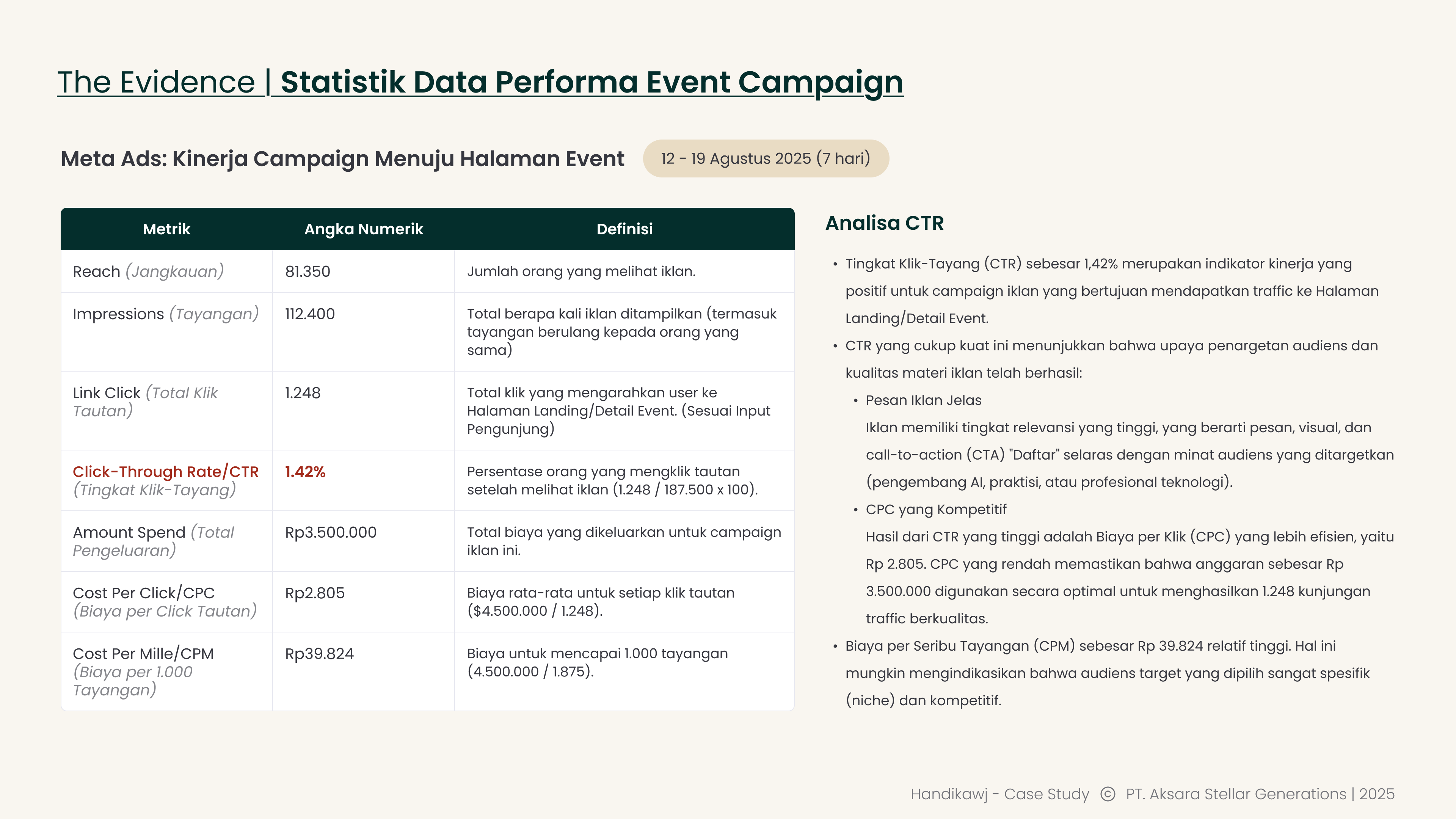
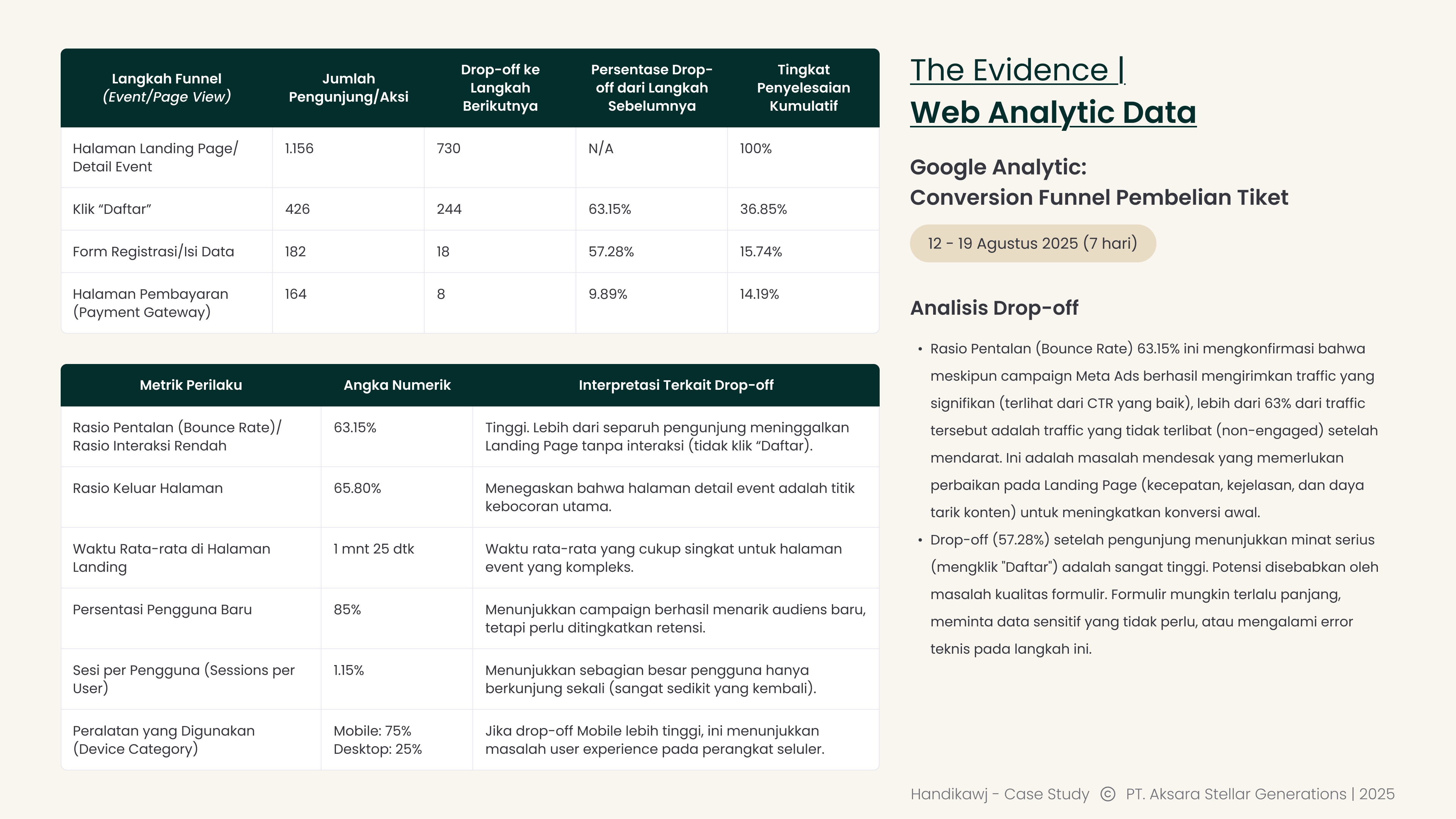
Data from the National AI Talent Development Program-Jakarta (Aug 13–20, 2025) indicates an inconsistent correlation between traffic, engagement time, and actual conversions. This misalignment poses a challenge in meeting our established lead and conversion targets. Moving forward, we are prioritizing a deep dive into lead quality to ensure higher conversion potential in future iterations.
Phase 2: Define
This segment focuses on distilling research findings to define the core challenges of the StellarGens Event feature, ensuring we prioritize the most impactful improvements.
This segment is part of the “Case Study: User Experience Research” activity.
A.
Insights
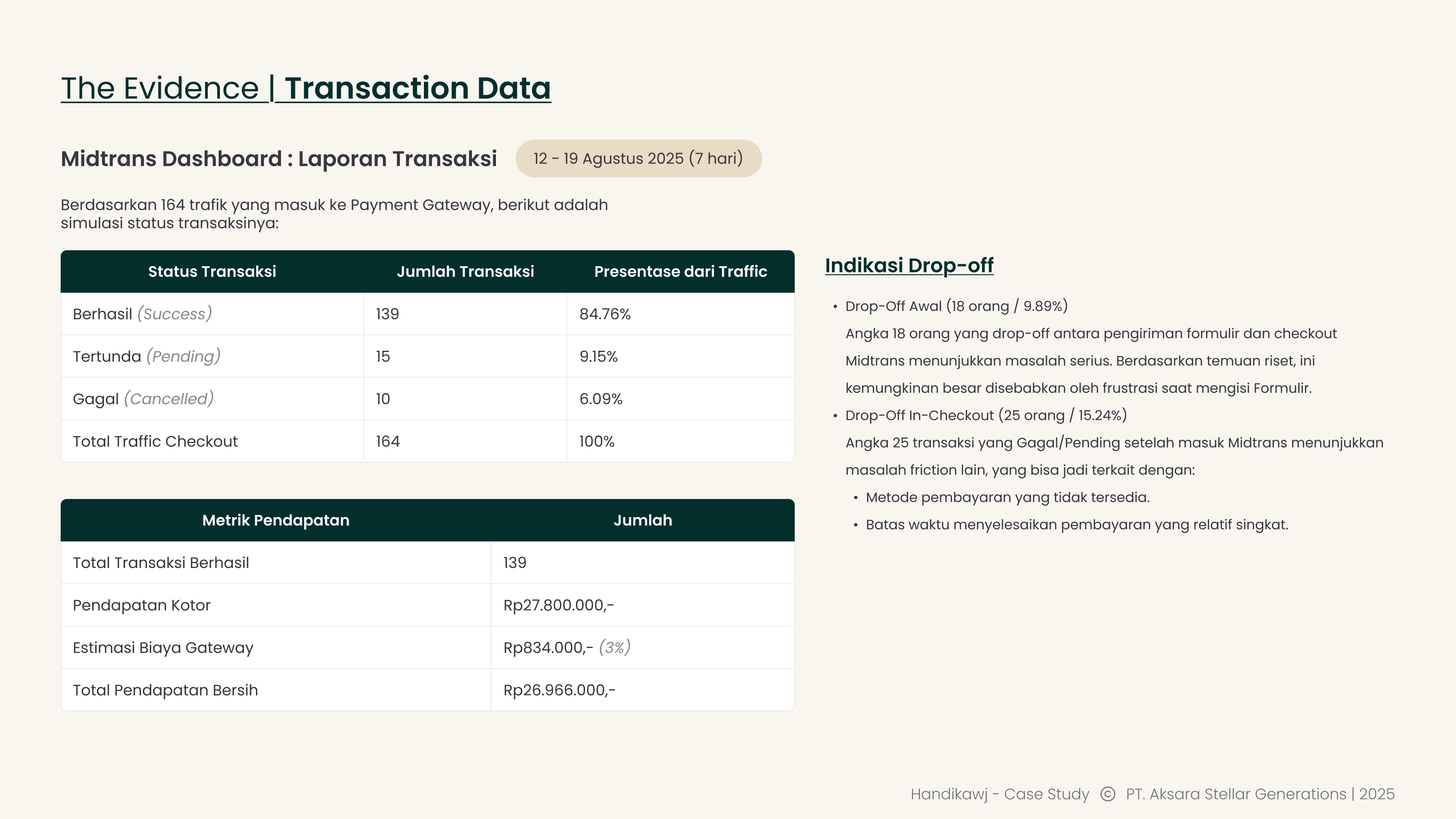
Compiling data recaps and analysis as authentic evidence to validate issues, ensuring the root cause is accurately identified based on facts.
B.
Themes
Grouping recurring problem patterns and simplifying complex research findings into strategic categories.
B. 1.
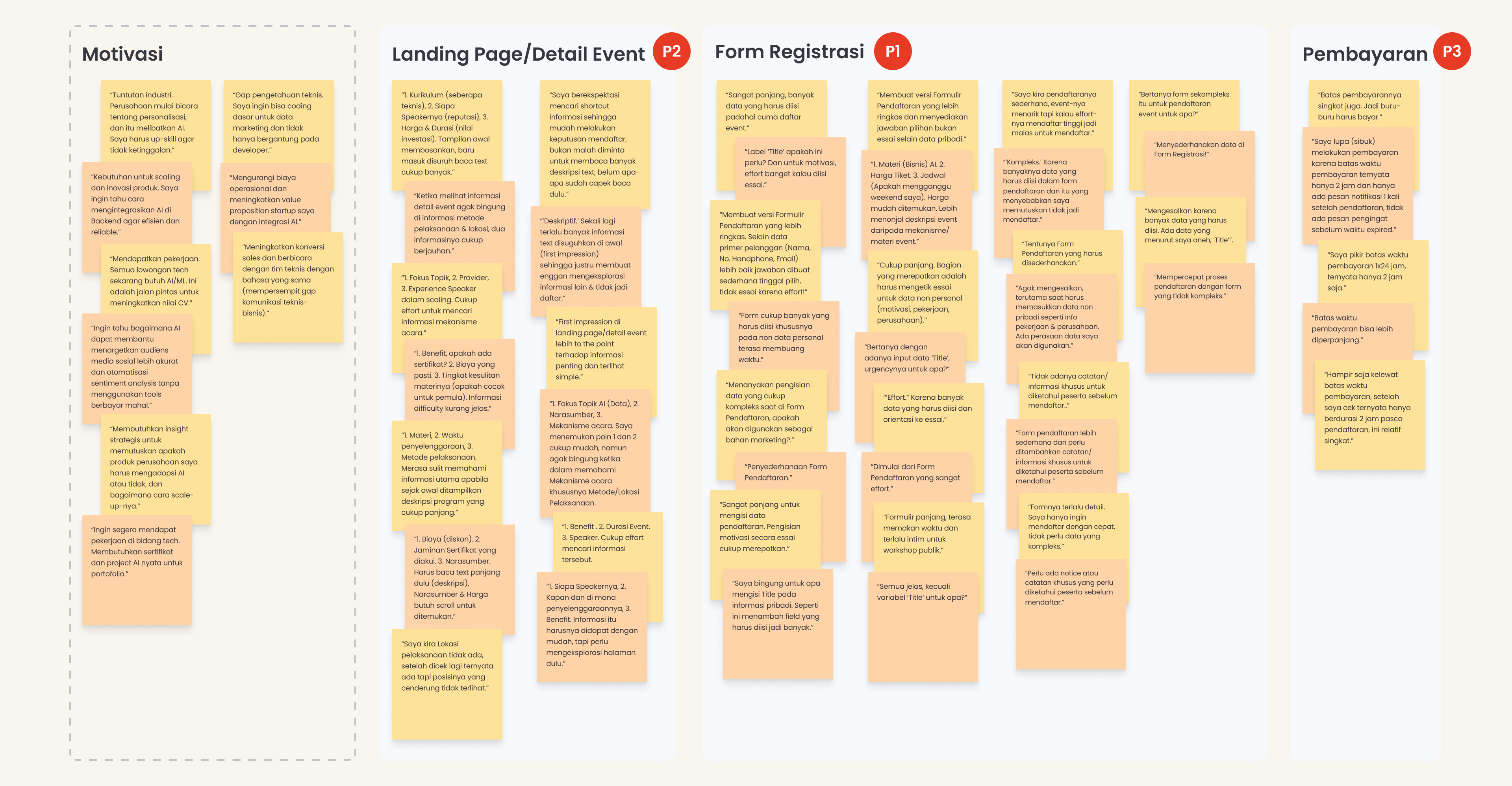
Affinity Diagram
Categorizing research findings to identify recurring patterns, key themes, and the interconnections between user problems.
B. 2.
Problem Identification
Transforming information clusters into identified user pain points, ensuring design efforts are centered on the most impactful hurdles.
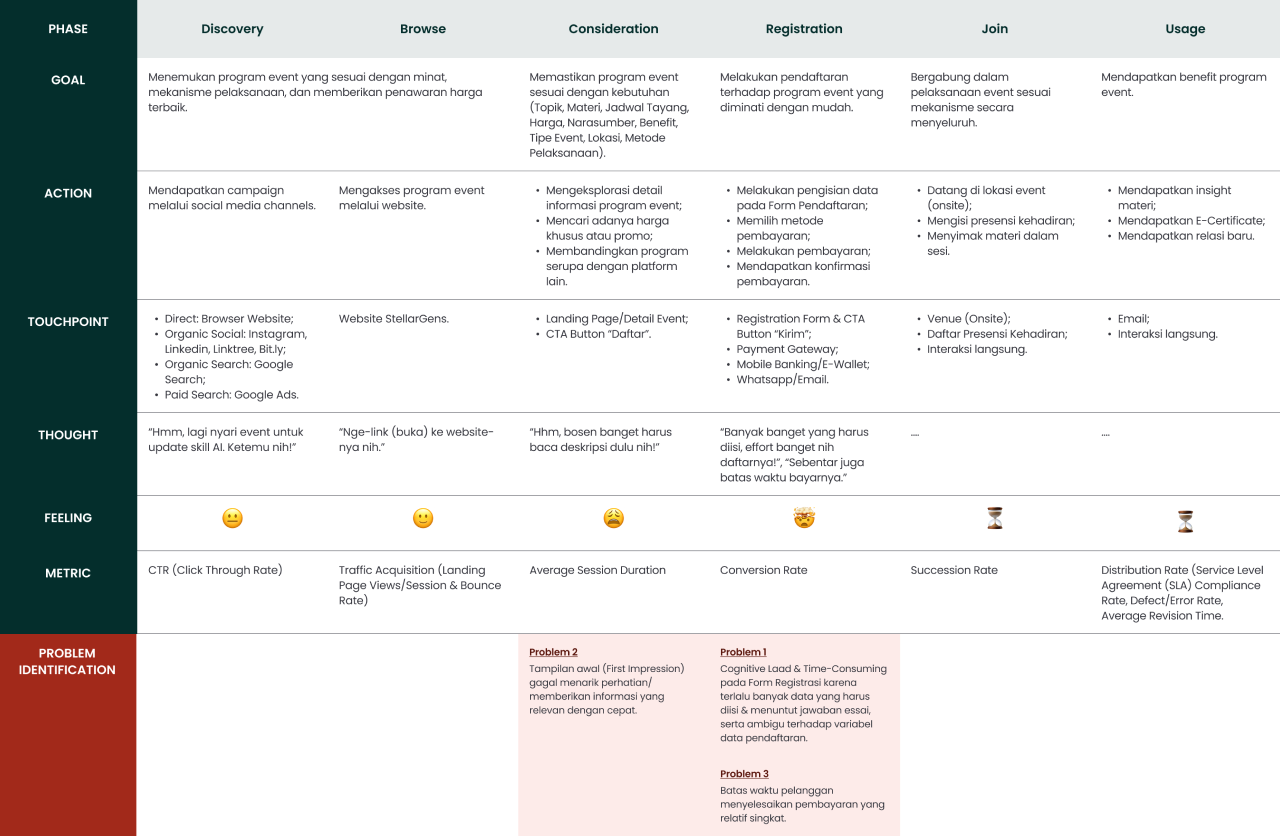
B. 3.
Analysis (Critical Findings) & Synthesis
Research findings reveal a fatal misalignment between the effort required from users and the value provided by the product, with friction emerging at every crucial phase of the user journey.
Problem 1
High Cognitive Load and Time-Consuming Registration Process
The issue with the registration form isn't just the number of fields, but the requirement for essay-style answers. Psychologically, this forces users to shift from Fast Thinking to Heavy Thinking mode.
Synthesis
Users experience fatigue before completing the registration within the conversion flow. We are losing user motivation and momentum right at the entry point due to a process that feels heavy cognitive load.
Problem 2
Expectation Mismatch on First Impression
The failure of the initial interface indicates a clear relevance gap. Users arrive motivated to grasp information as quickly as possible, yet the program greets them with text-heavy, generic, or poorly directed content.
Synthesis
There is a disconnect between the marketing promise, the moment they decide to click and the product reality. If the first 5–10 seconds fail to validate user needs, they subconsciously conclude that the product is not for me.
Problem 3
Support Deficit during the Transactional Phase
Short payment windows without effective reminders create unnecessary stress points and increase the risk of human error.
Synthesis
We erroneously assume users have undivided attention, when in reality, they face constant real world distractions. Failing at this stage is particularly costly because it occurs among high intent users. We are not losing them due to a lack of interest, but because our system is not tolerant enough of human error (forgetfulness/distraction)

Extracting critical findings to transform raw observations into deep strategic insights regarding user behavior and expectations.
C.
Opportunity Area
Transforming challenges into innovation opportunities by identifying critical user journey areas with the greatest room for improvement, delivering added value while achieving business targets.
C. 1.
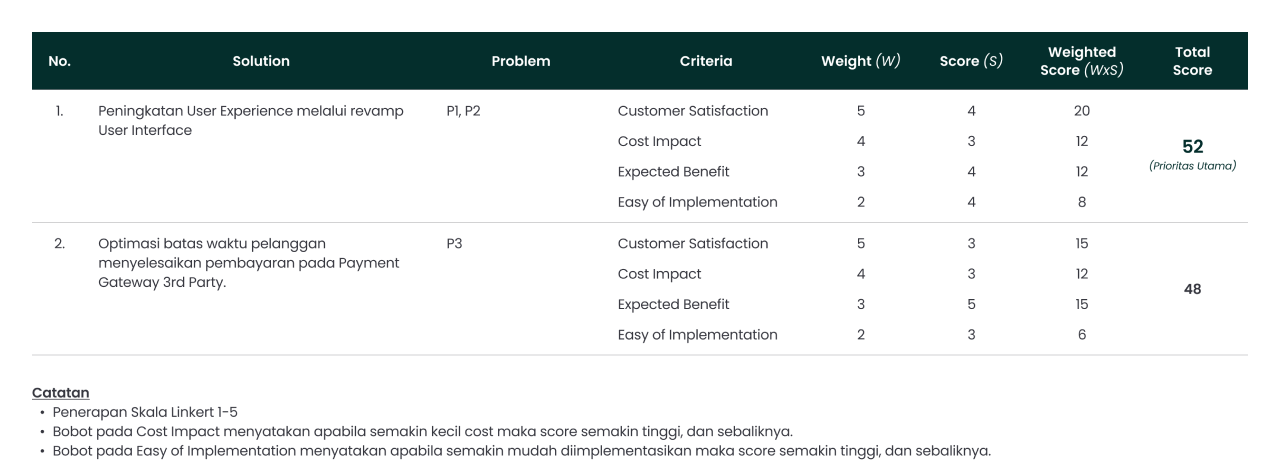
Solution Selection Matrix
Developing an evaluation framework to prioritize solutions based on the balance between user value and technical feasibility, ensuring resources are allocated to the most impactful features.
C. 2.
Strategic Decision Recommendations
Top Priority: Enhancing User Experience through a Strategic User Interface Revamp.
To address the conversion challenges, the immediate priority is to enhance User Experience through a UI revamp, focusing on two crucial elements:
Landing Page/Detail Event
Goal :
Capturing attention within the first 5-10 seconds to convey core value, while providing structured and persuasive information.Revamp Focus:
Dominant placement of critical information, paired with high-quality visuals that are deeply relevant to the market segment.
Registration From
Goal :
Reducing user burden and streamlining processes (Cognitive Load & Time-Consuming), while maximizing completion rates.Revamp Focus :
Validation and optimization of mandatory data inputs.
Tactical recommendations designed to mitigate user barriers and maximize market opportunities, ensuring every design decision is grounded in valid and measurable data.
D.
How Might We
Formulating design challenges into solution-oriented prompts. How Might We (HMW) questions serve as an ideation bridge, turning specific hurdles into measurable, user-centric design opportunities.
Based on our research findings, the key question we face is:
How might we increase event conversions by creating a compelling first impression on the Detail Page?
How might we eliminate procedural hurdles in the Registration Form to ensure a frictionless transition from interest to conversion?
Phase 3: Develop
This segment focuses on exploring solutions through creative ideation and prototyping iteratively validating design concepts to ensure StellarGens event features are not only aesthetic but also meet the users functional needs.
A.
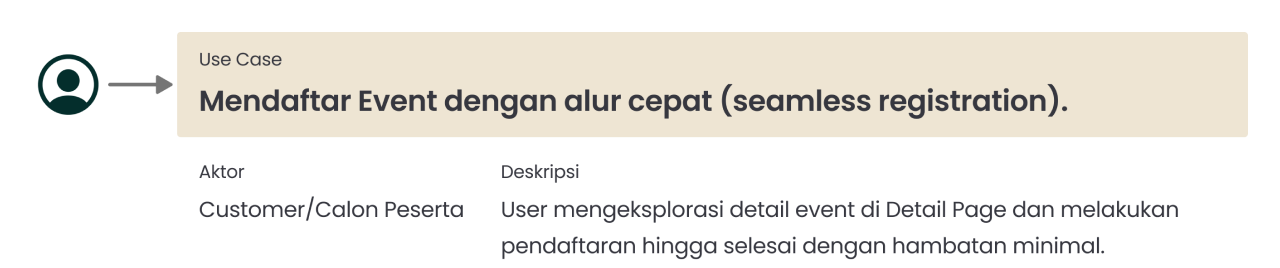
User Case
Defining specific interactions between the user and the system. Map out functional scenarios to ensure StellarGens Event feature fulfills user goals logically and effectively.
B.
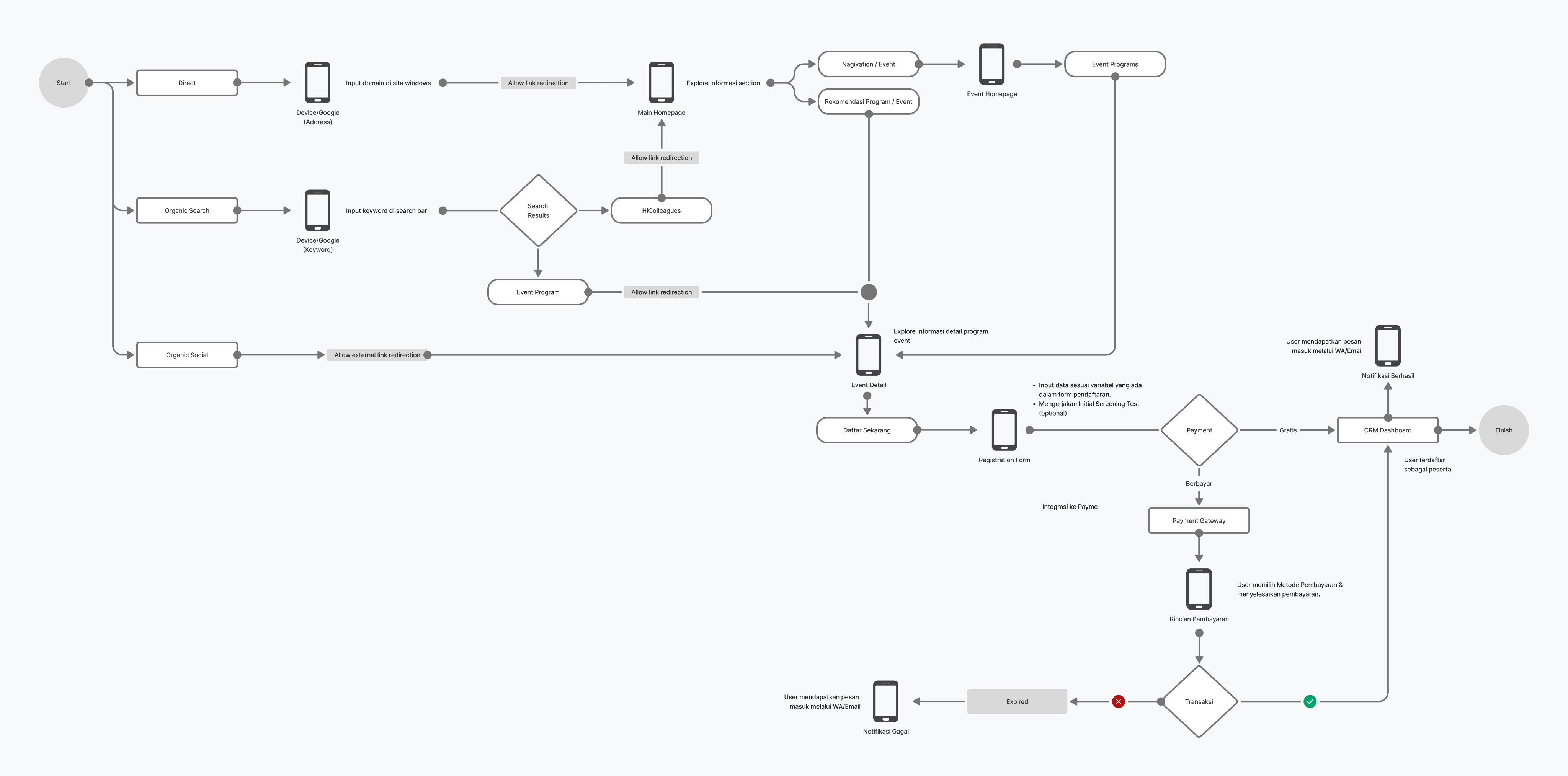
User Flow
Visualizing the step by step user journey to complete tasks. Optimize navigation flows to minimize friction and accelerate the users path toward ticket conversion.
C.
Sitemap
A hierarchical representation of all pages, ensuring logical content grouping and providing a comprehensive overview of the Event features navigation ecosystem.

D.
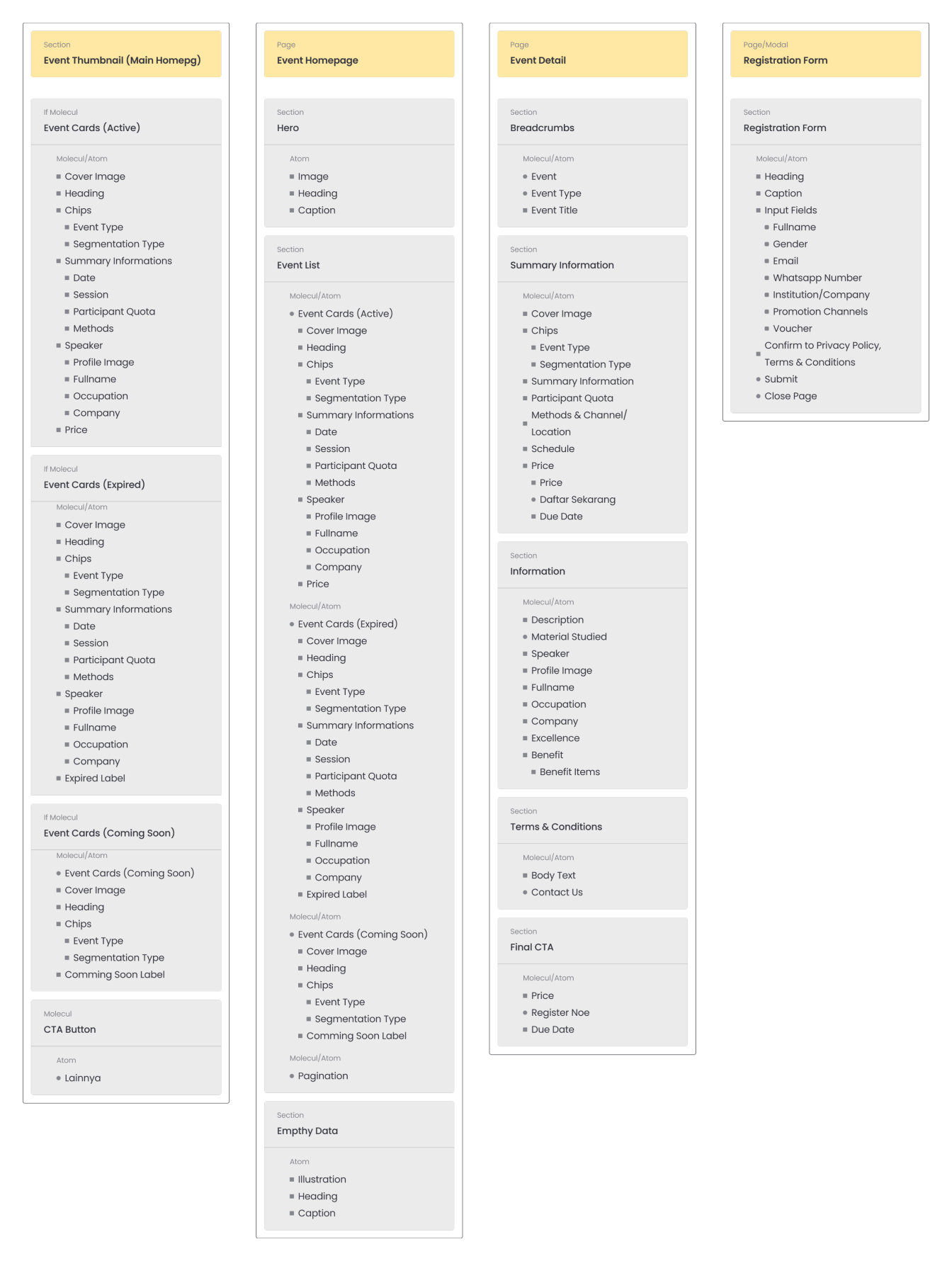
Information Architecture
Developing an intuitive information structure by organizing content and functionality, ensuring users can find event information easily without excessive cognitive load.
E.
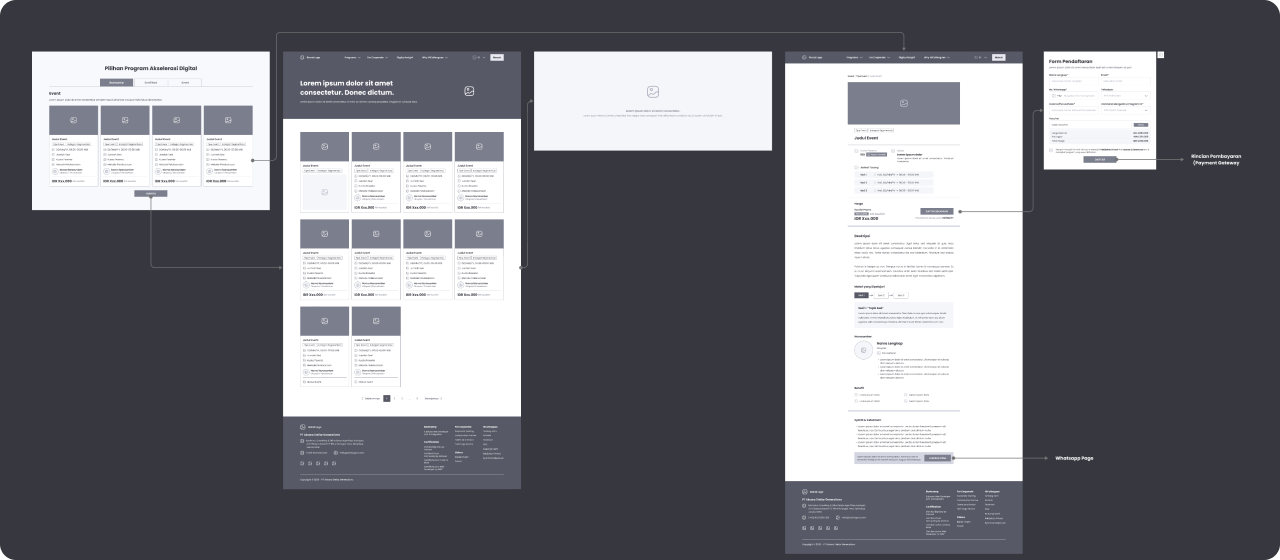
Wireframe
A low fidelity visual framework to validate layout and content hierarchy. It focuses on functionality and user experience before moving into detailed visual design.
F.
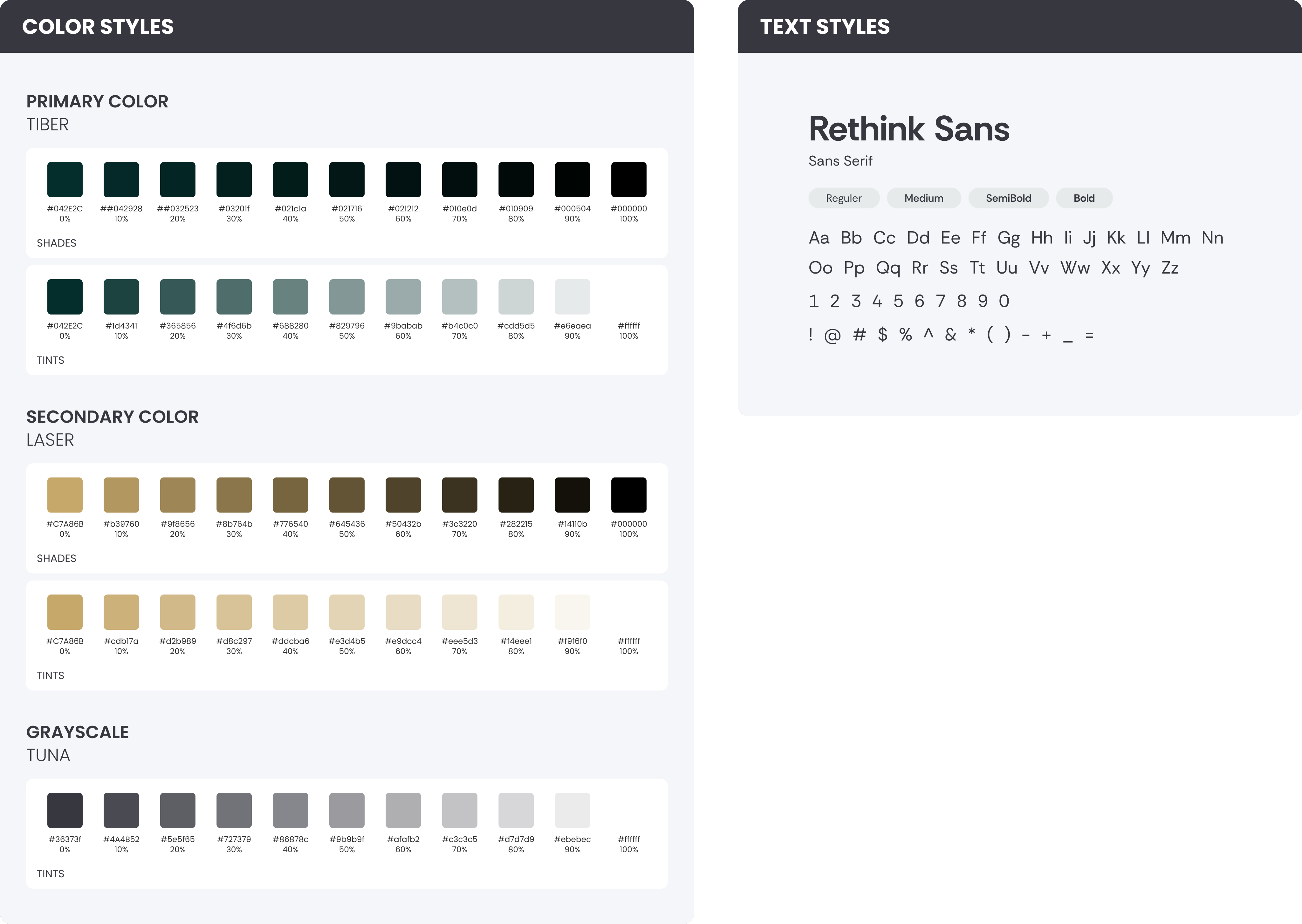
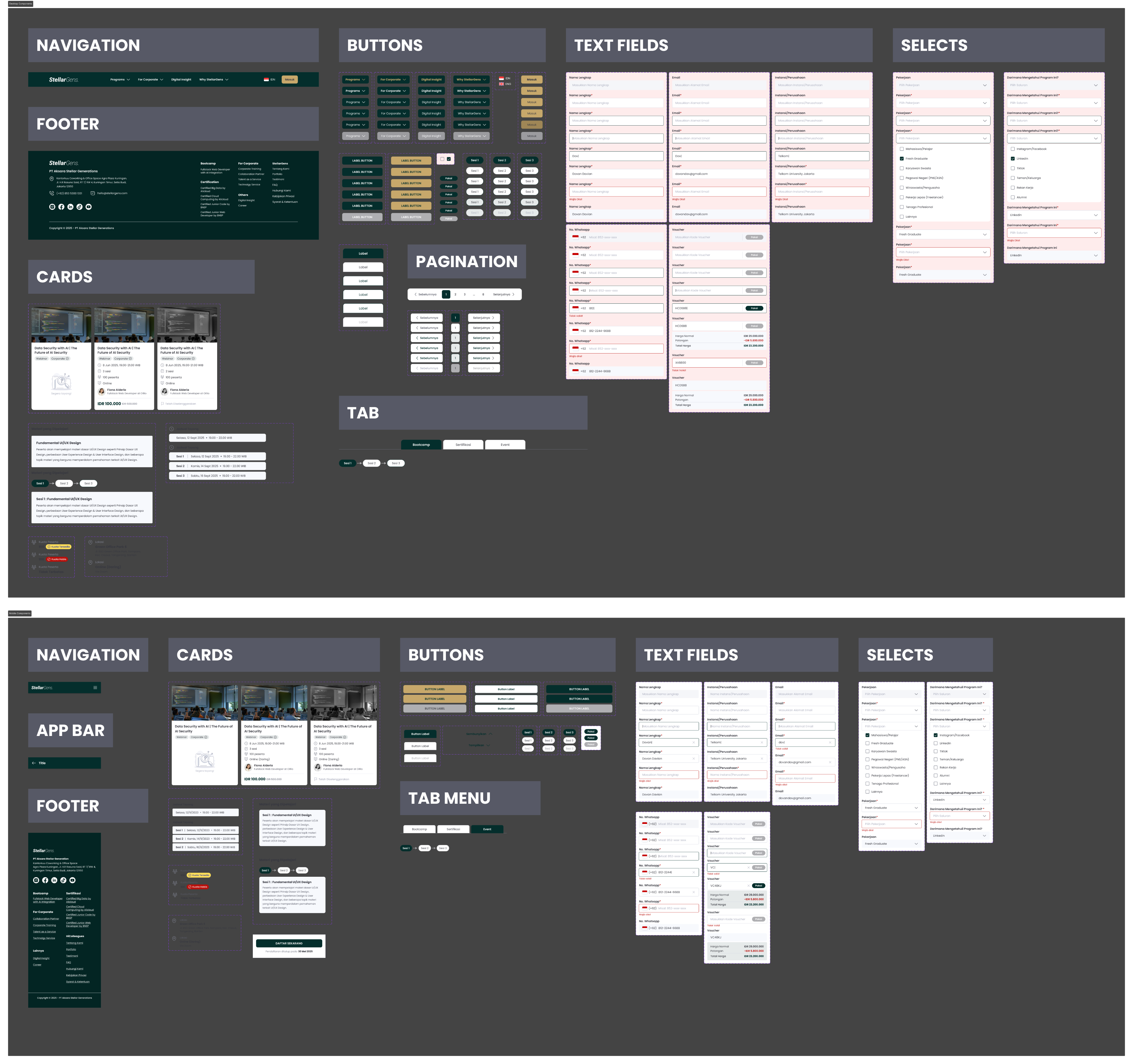
Design System
Building a consistent and scalable UI component library. Establishing visual standards (color, typography, elements) to accelerate the development process while maintaining a consistent and harmonious StellarGens brand identity.
G.
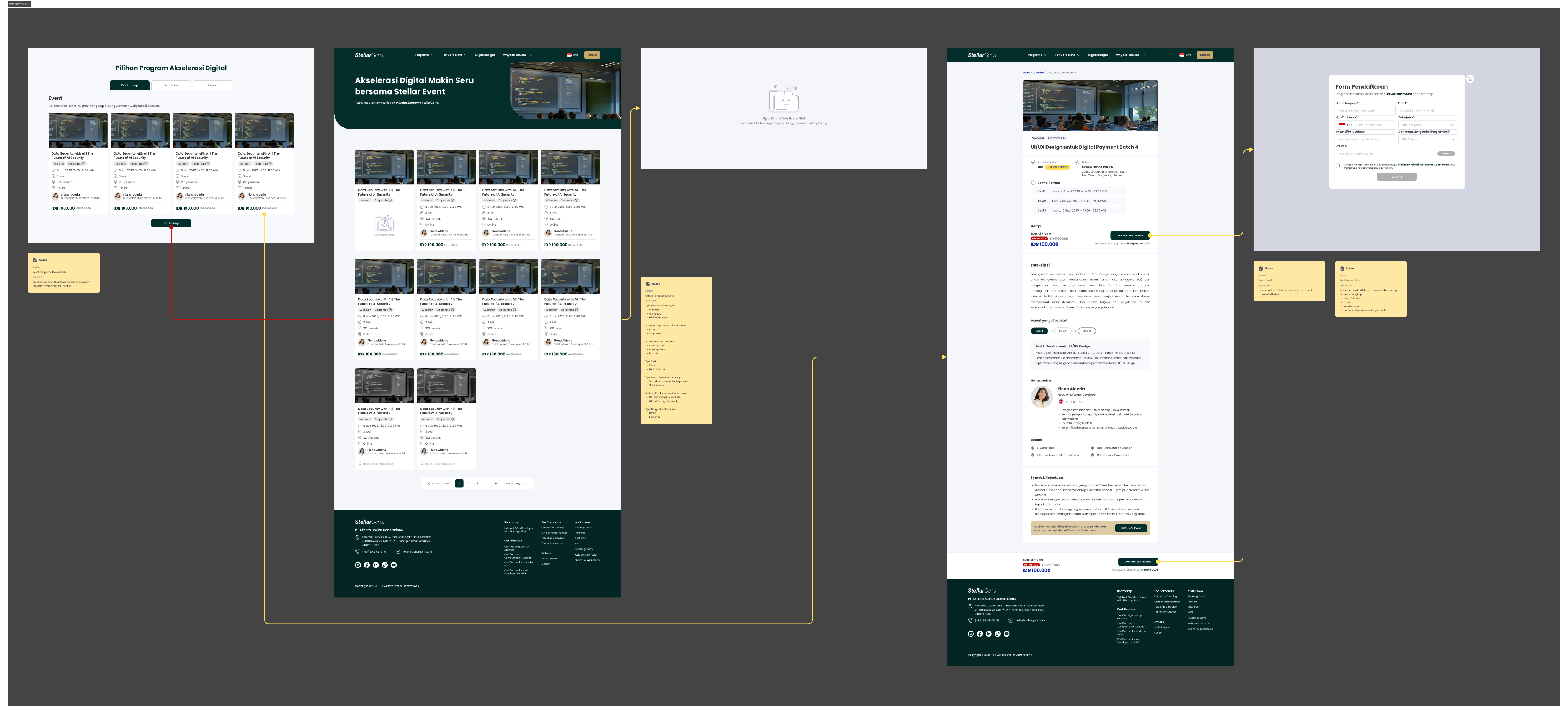
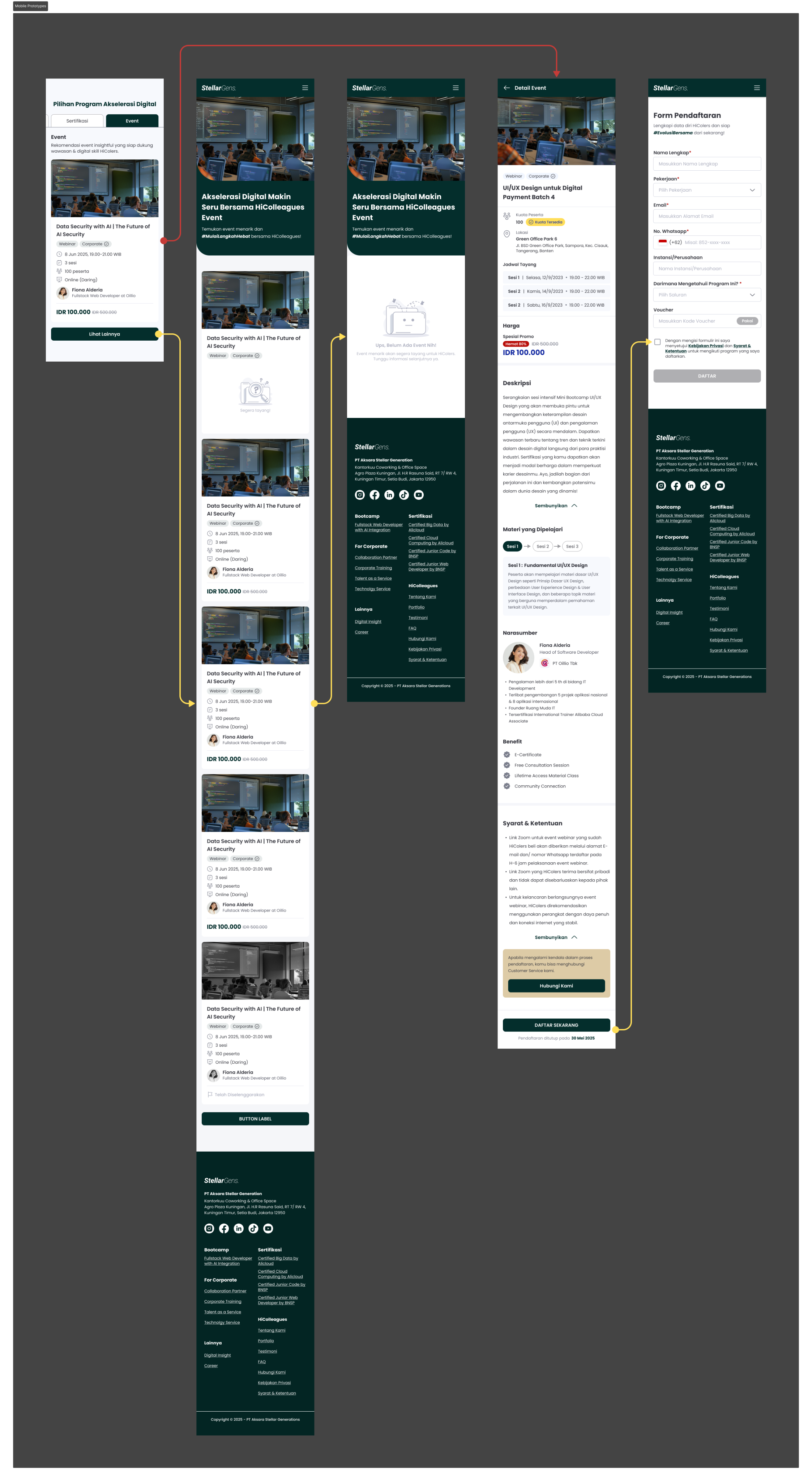
Prototype
Developing interactive high fidelity visualizations to test design workflows in realtime. This prototype allows us to experience the user journey before full production, ultimately reducing development costs.
Phase 4: Deliver
This segment focuses on the finalization and real world testing of our solutions. Through Usability Testing and high fidelity refinements, we ensure the product is ready for implementation to drive measurable and sustainable conversions.
A.
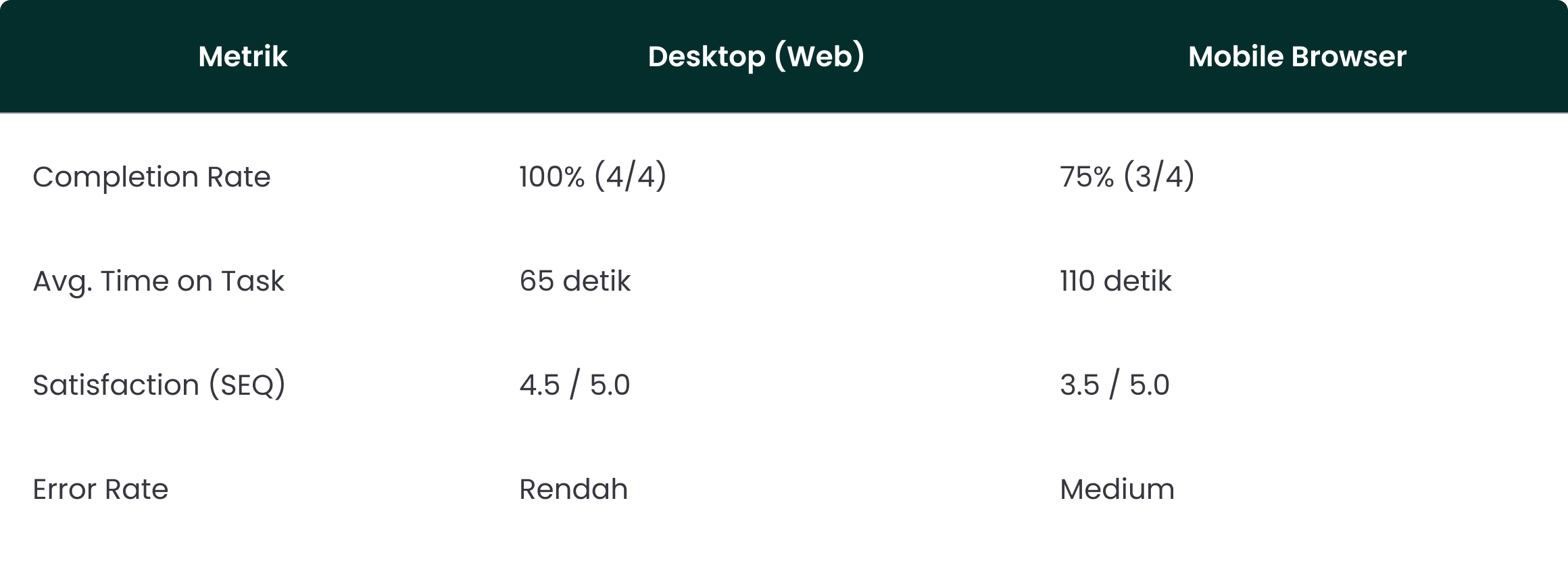
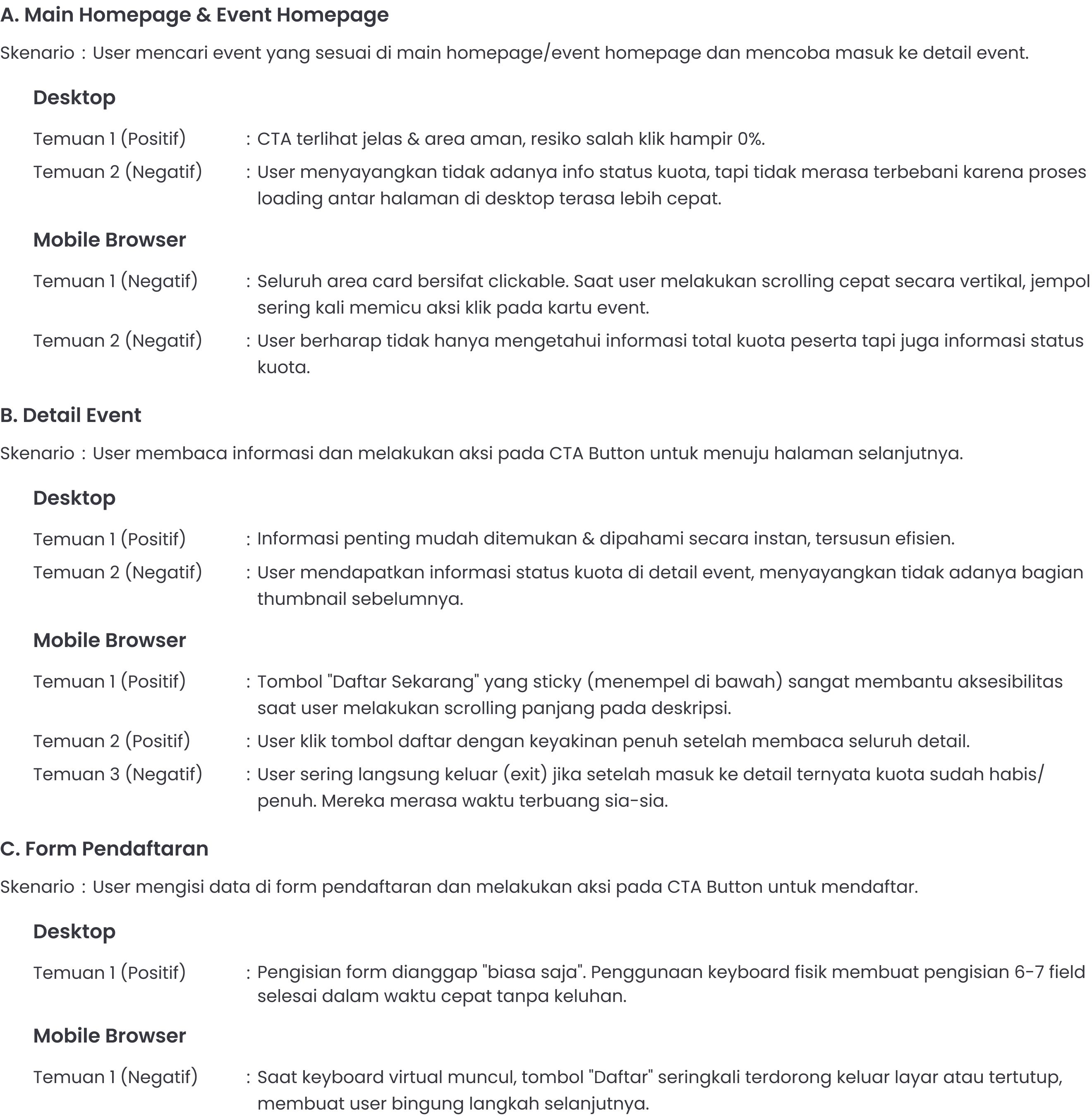
Usability Testing
Validating solutions directly with end users. Measuring task success rates and ease of use to identify any remaining hurdles before the event feature is officially launched.
Focus
:
Evaluating Event registration scenarios in accordance with the Conversion Flow.
Number of Participants
:
8 participants (4 Desktop, 4 Mobile Browser)
Success Metrics
Analysis
Conclusion & Recommendation for Improvisation
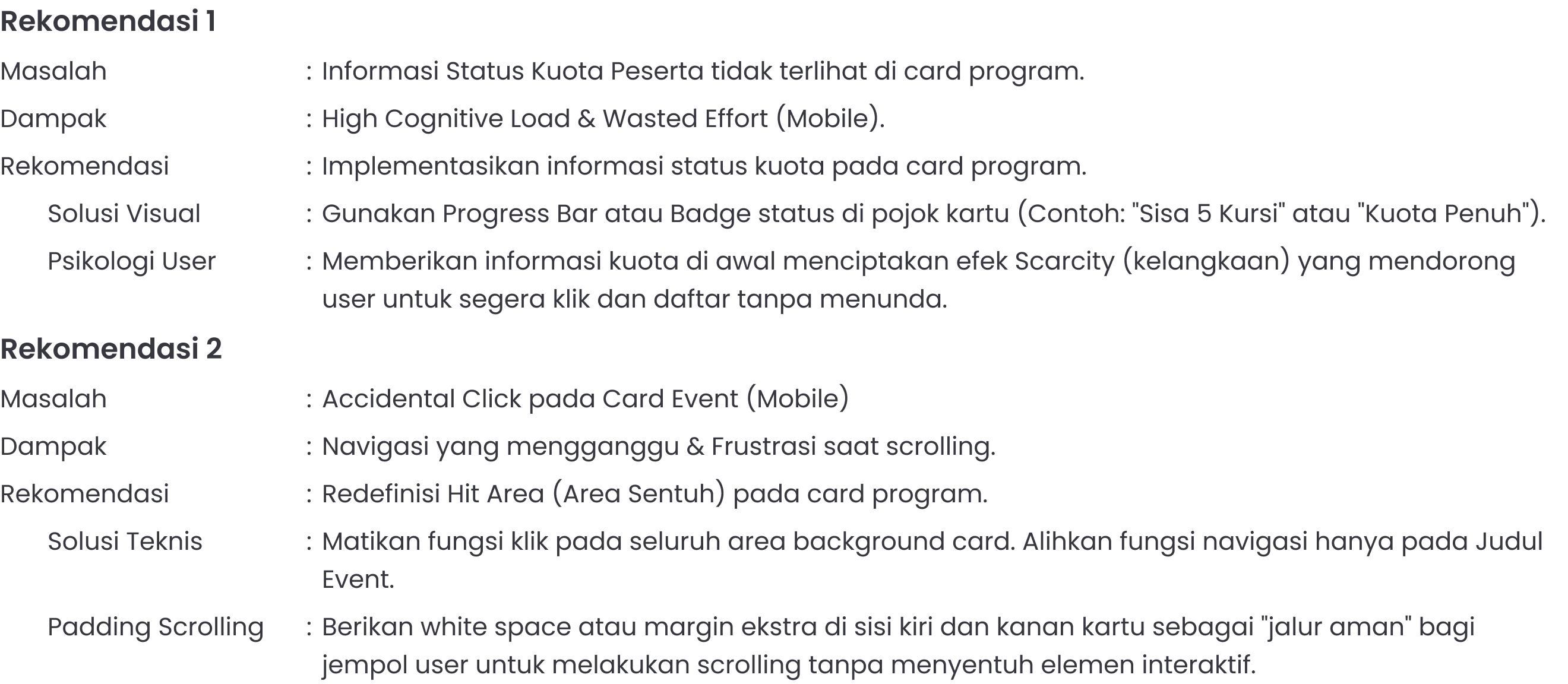
B.
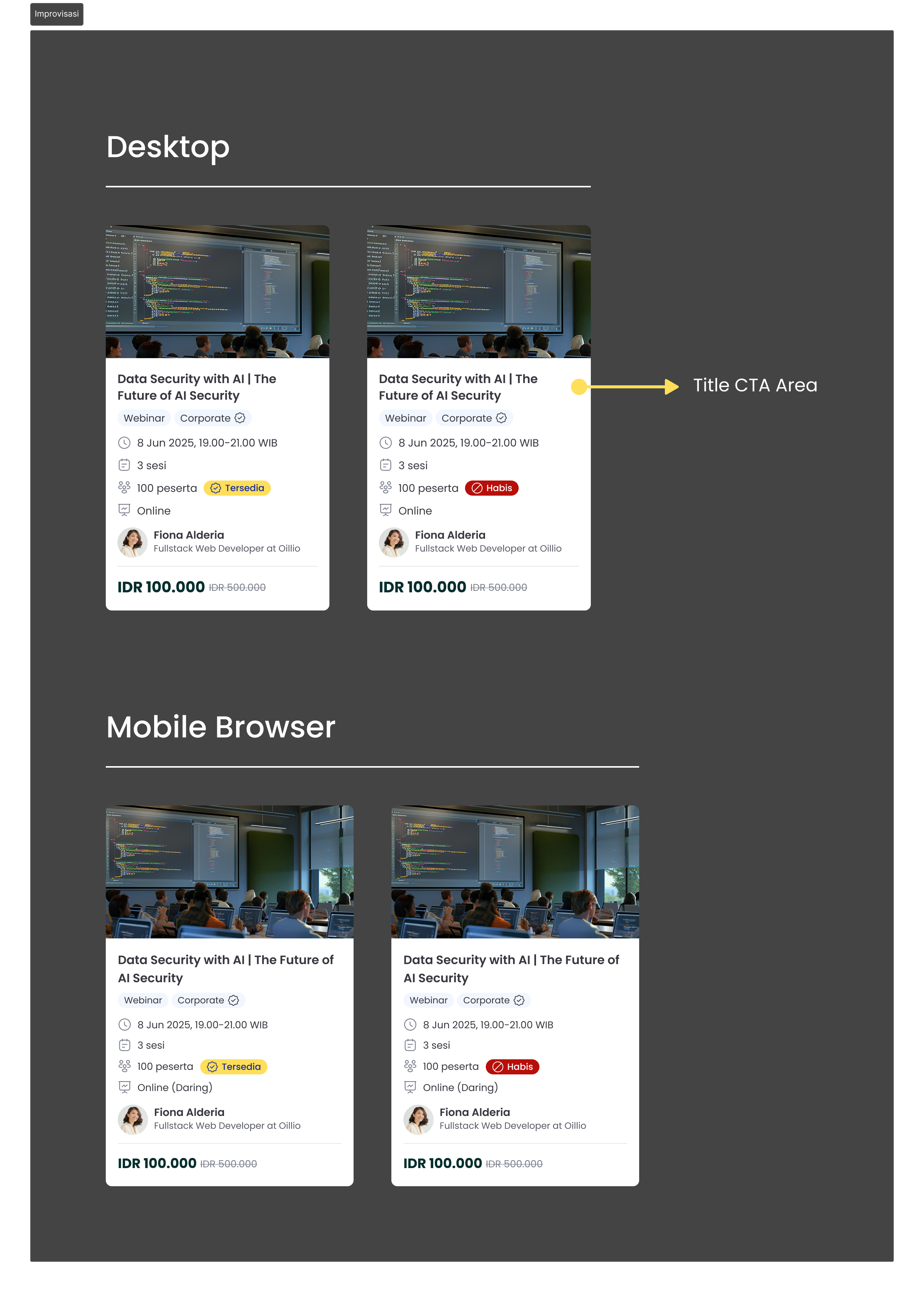
Improvisation
Conducting design iterations based on test findings. Refined critical elements that caused user confusion to ensure a smoother and more effective conversion flow for StellarGens.
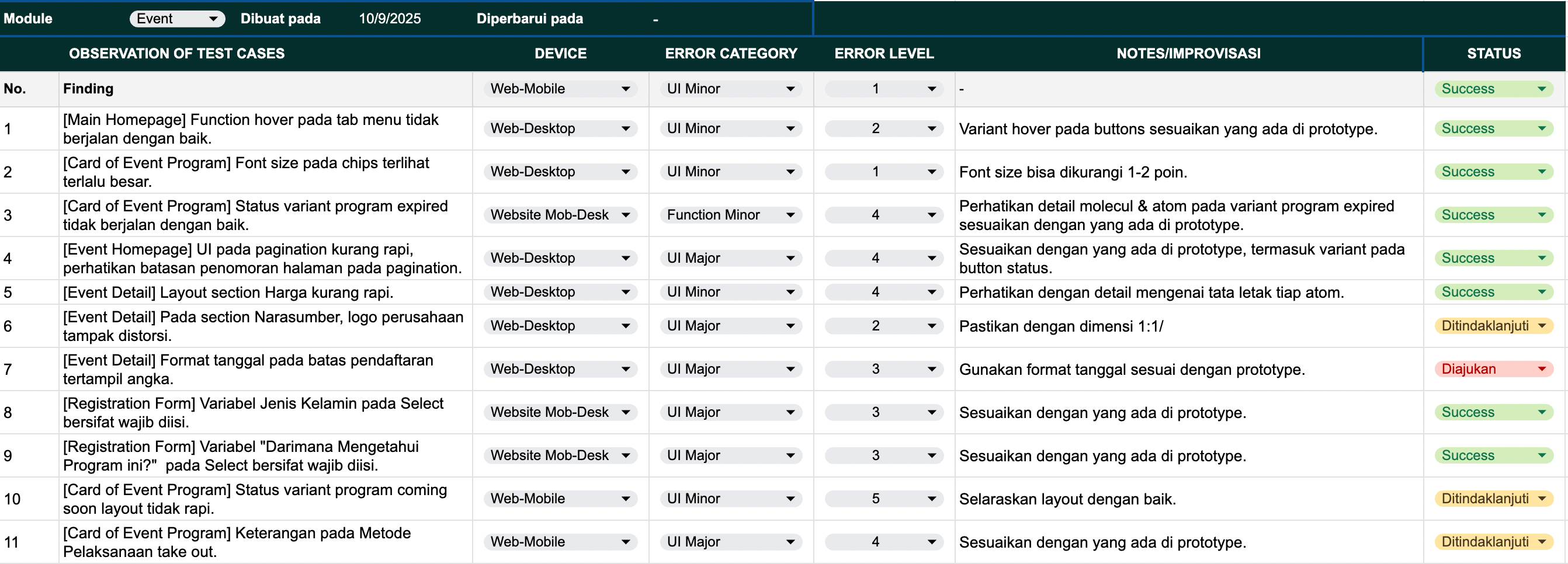
C.
Quality Assurance
Following the development iteration, we conducted a final check to ensure the implemented design aligns with initial specifications. This serves to minimize bugs and visual anomalies, providing a stable and frictionless user experience.
Once this phase is complete, we move to the Deployment stage. Following the launch, we will conduct periodic iterations to address any new pain points or emerging user stories.

Takeaways
Through this case study, I gained a deep understanding of the Double Diamond framework. Here are my key learning points:
Data-Driven Empathy
The Double Diamond framework proves that the best solutions stem from accurate pain point mapping, not assumptions. Understanding 'why' users drop off mid-journey is far more valuable than simply beautifying the UI.
Iteration is Key
The iteration phase post Usability Testing taught me that a first design is rarely perfect. Minor adjustments to the Information Architecture, driven by real user feedback, proved to be highly effective in significantly reducing user cognitive load.
Consistency Builds Trust and Identity
Implementing a Design System is about more than just aesthetics, its about building brand trust. Consistent visuals foster a sense of security for users when performing ticket transactions on StellarGens.
Focusing on the Happy Path
By optimizing and streamlining the User Flow, I successfully eliminated redundant steps. This directly resulted in improved time efficiency for users reaching the checkout stage.
Cross Phase Collaboration
The process from Discovery to Quality Assurance ensures that the initial design vision remains intact until release, minimizing the gap between design expectations and technical reality.
Through the Double Diamond framework, the development of StellarGens Event feature transformed from a simple visual update into a strategic solution focused on transaction ease. The result is an experience that is not only intuitive but also drives measurable conversions.

Handikawj - Product & UI/UX Designer | 2026
Case Study
Optimizing User Experience to Boost Conversions on the StellarGens Event Feature
Project Scope
UX/UI with Double Diamond
Company (Dummy)
StellarGens
Business Field
Edutech
Phase 1: Discover
This segment focuses on understanding StellarGens background and challenges through in-depth research to uncover key pain points.
A.
Company Profile
StellarGens (PT Aksara Stellar Generations) is a Jakarta-based edutech and outsourcing startup focused on professional capability development. Its flagship services include training, certification, and human resource solutions. Through innovative strategies, StellarGens empowers organizations and individuals to remain relevant amidst dynamic digital transformations across various industrial sectors.
B.
Problem Statement
Data from the National AI Talent Development Program-Jakarta (Aug 13–20, 2025) indicates an inconsistent correlation between traffic, engagement time, and actual conversions. This misalignment poses a challenge in meeting our established lead and conversion targets. Moving forward, we are prioritizing a deep dive into lead quality to ensure higher conversion potential in future iterations.
Phase 2: Define
This segment focuses on distilling research findings to define the core challenges of the StellarGens Event feature, ensuring we prioritize the most impactful improvements.
This segment is part of the “Case Study: User Experience Research” activity.
A.
Insights
Compiling data recaps and analysis as authentic evidence to validate issues, ensuring the root cause is accurately identified based on facts.
B.
Themes
Grouping recurring problem patterns and simplifying complex research findings into strategic categories.
B. 1.
Affinity Diagram
Categorizing research findings to identify recurring patterns, key themes, and the interconnections between user problems.
B. 2.
Problem Identification
Transforming information clusters into identified user pain points, ensuring design efforts are centered on the most impactful hurdles.
B. 3.
Analysis (Critical Findings) & Synthesis
Research findings reveal a fatal misalignment between the effort required from users and the value provided by the product, with friction emerging at every crucial phase of the user journey.
Problem 1
High Cognitive Load and Time-Consuming Registration Process
The issue with the registration form isn't just the number of fields, but the requirement for essay-style answers. Psychologically, this forces users to shift from Fast Thinking to Heavy Thinking mode.
Synthesis
Users experience fatigue before completing the registration within the conversion flow. We are losing user motivation and momentum right at the entry point due to a process that feels heavy cognitive load.
Problem 2
Expectation Mismatch on First Impression
The failure of the initial interface indicates a clear relevance gap. Users arrive motivated to grasp information as quickly as possible, yet the program greets them with text-heavy, generic, or poorly directed content.
Synthesis
There is a disconnect between the marketing promise, the moment they decide to click and the product reality. If the first 5–10 seconds fail to validate user needs, they subconsciously conclude that the product is not for me.
Problem 3
Support Deficit during the Transactional Phase
Short payment windows without effective reminders create unnecessary stress points and increase the risk of human error.
Synthesis
We erroneously assume users have undivided attention, when in reality, they face constant real world distractions. Failing at this stage is particularly costly because it occurs among high intent users. We are not losing them due to a lack of interest, but because our system is not tolerant enough of human error (forgetfulness/distraction)
Extracting critical findings to transform raw observations into deep strategic insights regarding user behavior and expectations.
C.
Opportunity Area
Transforming challenges into innovation opportunities by identifying critical user journey areas with the greatest room for improvement, delivering added value while achieving business targets.
C. 1.
Solution Selection Matrix
Developing an evaluation framework to prioritize solutions based on the balance between user value and technical feasibility, ensuring resources are allocated to the most impactful features.
C. 2.
Strategic Decision Recommendations
Top Priority: Enhancing User Experience through a Strategic User Interface Revamp.
To address the conversion challenges, the immediate priority is to enhance User Experience through a UI revamp, focusing on two crucial elements:
Landing Page/Detail Event
Goal :
Capturing attention within the first 5-10 seconds to convey core value, while providing structured and persuasive information.Revamp Focus:
Dominant placement of critical information, paired with high-quality visuals that are deeply relevant to the market segment.
Registration From
Goal :
Reducing user burden and streamlining processes (Cognitive Load & Time-Consuming), while maximizing completion rates.Revamp Focus :
Validation and optimization of mandatory data inputs.
Tactical recommendations designed to mitigate user barriers and maximize market opportunities, ensuring every design decision is grounded in valid and measurable data.
D.
How Might We
Formulating design challenges into solution-oriented prompts. How Might We (HMW) questions serve as an ideation bridge, turning specific hurdles into measurable, user-centric design opportunities.
Based on our research findings, the key question we face is:
How might we increase event conversions by creating a compelling first impression on the Detail Page?
How might we eliminate procedural hurdles in the Registration Form to ensure a frictionless transition from interest to conversion?
Phase 3: Develop
This segment focuses on exploring solutions through creative ideation and prototyping iteratively validating design concepts to ensure StellarGens event features are not only aesthetic but also meet the users functional needs.
A.
User Case
Defining specific interactions between the user and the system. Map out functional scenarios to ensure StellarGens Event feature fulfills user goals logically and effectively.
B.
User Flow
Visualizing the step by step user journey to complete tasks. Optimize navigation flows to minimize friction and accelerate the users path toward ticket conversion.
C.
Sitemap
A hierarchical representation of all pages, ensuring logical content grouping and providing a comprehensive overview of the Event features navigation ecosystem.
D.
Information Architecture
Developing an intuitive information structure by organizing content and functionality, ensuring users can find event information easily without excessive cognitive load.
E.
Wireframe
A low fidelity visual framework to validate layout and content hierarchy. It focuses on functionality and user experience before moving into detailed visual design.
F.
Design System
Building a consistent and scalable UI component library. Establishing visual standards (color, typography, elements) to accelerate the development process while maintaining a consistent and harmonious StellarGens brand identity.
G.
Prototype
Developing interactive high fidelity visualizations to test design workflows in realtime. This prototype allows us to experience the user journey before full production, ultimately reducing development costs.
Phase 4: Deliver
This segment focuses on the finalization and real world testing of our solutions. Through Usability Testing and high fidelity refinements, we ensure the product is ready for implementation to drive measurable and sustainable conversions.
A.
Usability Testing
Validating solutions directly with end users. Measuring task success rates and ease of use to identify any remaining hurdles before the event feature is officially launched.
Focus
:
Evaluating Event registration scenarios in accordance with the Conversion Flow.
Number of Participants
:
8 participants (4 Desktop, 4 Mobile Browser)
Success Metrics
Analysis
Conclusion & Recommendation for Improvisation
B.
Improvisation
Conducting design iterations based on test findings. Refined critical elements that caused user confusion to ensure a smoother and more effective conversion flow for StellarGens.
C.
Quality Assurance
Following the development iteration, we conducted a final check to ensure the implemented design aligns with initial specifications. This serves to minimize bugs and visual anomalies, providing a stable and frictionless user experience.
Once this phase is complete, we move to the Deployment stage. Following the launch, we will conduct periodic iterations to address any new pain points or emerging user stories.
Takeaways
Through this case study, I gained a deep understanding of the Double Diamond framework. Here are my key learning points:
Data-Driven Empathy
The Double Diamond framework proves that the best solutions stem from accurate pain point mapping, not assumptions. Understanding 'why' users drop off mid-journey is far more valuable than simply beautifying the UI.
Iteration is Key
The iteration phase post Usability Testing taught me that a first design is rarely perfect. Minor adjustments to the Information Architecture, driven by real user feedback, proved to be highly effective in significantly reducing user cognitive load.
Consistency Builds Trust and Identity
Implementing a Design System is about more than just aesthetics, its about building brand trust. Consistent visuals foster a sense of security for users when performing ticket transactions on StellarGens.
Focusing on the Happy Path
By optimizing and streamlining the User Flow, I successfully eliminated redundant steps. This directly resulted in improved time efficiency for users reaching the checkout stage.
Cross Phase Collaboration
The process from Discovery to Quality Assurance ensures that the initial design vision remains intact until release, minimizing the gap between design expectations and technical reality.
Through the Double Diamond framework, the development of StellarGens Event feature transformed from a simple visual update into a strategic solution focused on transaction ease. The result is an experience that is not only intuitive but also drives measurable conversions.
Handikawj - Product & UI/UX Designer | 2026
Case Study
Optimizing User Experience to Boost Conversions on the StellarGens Event Feature
Project Scope
UX/UI with Double Diamond
Company (Dummy)
StellarGens
Business Field
Edutech
Phase 1: Discover
This segment focuses on understanding StellarGens background and challenges through in-depth research to uncover key pain points.
A.
Company Profile
StellarGens (PT Aksara Stellar Generations) is a Jakarta-based edutech and outsourcing startup focused on professional capability development. Its flagship services include training, certification, and human resource solutions. Through innovative strategies, StellarGens empowers organizations and individuals to remain relevant amidst dynamic digital transformations across various industrial sectors.
B.
Problem Statement
Data from the National AI Talent Development Program-Jakarta (Aug 13–20, 2025) indicates an inconsistent correlation between traffic, engagement time, and actual conversions. This misalignment poses a challenge in meeting our established lead and conversion targets. Moving forward, we are prioritizing a deep dive into lead quality to ensure higher conversion potential in future iterations.
Phase 2: Define
This segment focuses on distilling research findings to define the core challenges of the StellarGens Event feature, ensuring we prioritize the most impactful improvements.
This segment is part of the “Case Study: User Experience Research” activity.
A.
Insights
Compiling data recaps and analysis as authentic evidence to validate issues, ensuring the root cause is accurately identified based on facts.
B.
Themes
Grouping recurring problem patterns and simplifying complex research findings into strategic categories.
B. 1.
Affinity Diagram
Categorizing research findings to identify recurring patterns, key themes, and the interconnections between user problems.
B. 2.
Problem Identification
Transforming information clusters into identified user pain points, ensuring design efforts are centered on the most impactful hurdles.
B. 3.
Analysis (Critical Findings) & Synthesis
Research findings reveal a fatal misalignment between the effort required from users and the value provided by the product, with friction emerging at every crucial phase of the user journey.
Problem 1
High Cognitive Load and Time-Consuming Registration Process
The issue with the registration form isn't just the number of fields, but the requirement for essay-style answers. Psychologically, this forces users to shift from Fast Thinking to Heavy Thinking mode.
Synthesis
Users experience fatigue before completing the registration within the conversion flow. We are losing user motivation and momentum right at the entry point due to a process that feels heavy cognitive load.
Problem 2
Expectation Mismatch on First Impression
The failure of the initial interface indicates a clear relevance gap. Users arrive motivated to grasp information as quickly as possible, yet the program greets them with text-heavy, generic, or poorly directed content.
Synthesis
There is a disconnect between the marketing promise, the moment they decide to click and the product reality. If the first 5–10 seconds fail to validate user needs, they subconsciously conclude that the product is not for me.
Problem 3
Support Deficit during the Transactional Phase
Short payment windows without effective reminders create unnecessary stress points and increase the risk of human error.
Synthesis
We erroneously assume users have undivided attention, when in reality, they face constant real world distractions. Failing at this stage is particularly costly because it occurs among high intent users. We are not losing them due to a lack of interest, but because our system is not tolerant enough of human error (forgetfulness/distraction)
Extracting critical findings to transform raw observations into deep strategic insights regarding user behavior and expectations.
C.
Opportunity Area
Transforming challenges into innovation opportunities by identifying critical user journey areas with the greatest room for improvement, delivering added value while achieving business targets.
C. 1.
Solution Selection Matrix
Developing an evaluation framework to prioritize solutions based on the balance between user value and technical feasibility, ensuring resources are allocated to the most impactful features.
C. 2.
Strategic Decision Recommendations
Top Priority: Enhancing User Experience through a Strategic User Interface Revamp.
To address the conversion challenges, the immediate priority is to enhance User Experience through a UI revamp, focusing on two crucial elements:
Landing Page/Detail Event
Goal :
Capturing attention within the first 5-10 seconds to convey core value, while providing structured and persuasive information.Revamp Focus:
Dominant placement of critical information, paired with high-quality visuals that are deeply relevant to the market segment.
Registration From
Goal :
Reducing user burden and streamlining processes (Cognitive Load & Time-Consuming), while maximizing completion rates.Revamp Focus :
Validation and optimization of mandatory data inputs.
Tactical recommendations designed to mitigate user barriers and maximize market opportunities, ensuring every design decision is grounded in valid and measurable data.
D.
How Might We
Formulating design challenges into solution-oriented prompts. How Might We (HMW) questions serve as an ideation bridge, turning specific hurdles into measurable, user-centric design opportunities.
Based on our research findings, the key question we face is:
How might we increase event conversions by creating a compelling first impression on the Detail Page?
How might we eliminate procedural hurdles in the Registration Form to ensure a frictionless transition from interest to conversion?
Phase 3: Develop
This segment focuses on exploring solutions through creative ideation and prototyping iteratively validating design concepts to ensure StellarGens event features are not only aesthetic but also meet the users functional needs.
A.
User Case
Defining specific interactions between the user and the system. Map out functional scenarios to ensure StellarGens Event feature fulfills user goals logically and effectively.
B.
User Flow
Visualizing the step by step user journey to complete tasks. Optimize navigation flows to minimize friction and accelerate the users path toward ticket conversion.
C.
Sitemap
A hierarchical representation of all pages, ensuring logical content grouping and providing a comprehensive overview of the Event features navigation ecosystem.
D.
Information Architecture
Developing an intuitive information structure by organizing content and functionality, ensuring users can find event information easily without excessive cognitive load.
E.
Wireframe
A low fidelity visual framework to validate layout and content hierarchy. It focuses on functionality and user experience before moving into detailed visual design.
F.
Design System
Building a consistent and scalable UI component library. Establishing visual standards (color, typography, elements) to accelerate the development process while maintaining a consistent and harmonious StellarGens brand identity.
G.
Prototype
Developing interactive high fidelity visualizations to test design workflows in realtime. This prototype allows us to experience the user journey before full production, ultimately reducing development costs.
Phase 4: Deliver
This segment focuses on the finalization and real world testing of our solutions. Through Usability Testing and high fidelity refinements, we ensure the product is ready for implementation to drive measurable and sustainable conversions.
A.
Usability Testing
Validating solutions directly with end users. Measuring task success rates and ease of use to identify any remaining hurdles before the event feature is officially launched.
Focus
:
Evaluating Event registration scenarios in accordance with the Conversion Flow.
Number of Participants
:
8 participants (4 Desktop, 4 Mobile Browser)
Success Metrics
Analysis
Conclusion & Recommendation for Improvisation
B.
Improvisation
Conducting design iterations based on test findings. Refined critical elements that caused user confusion to ensure a smoother and more effective conversion flow for StellarGens.
C.
Quality Assurance
Following the development iteration, we conducted a final check to ensure the implemented design aligns with initial specifications. This serves to minimize bugs and visual anomalies, providing a stable and frictionless user experience.
Once this phase is complete, we move to the Deployment stage. Following the launch, we will conduct periodic iterations to address any new pain points or emerging user stories.
Takeaways
Through this case study, I gained a deep understanding of the Double Diamond framework. Here are my key learning points:
Data-Driven Empathy
The Double Diamond framework proves that the best solutions stem from accurate pain point mapping, not assumptions. Understanding 'why' users drop off mid-journey is far more valuable than simply beautifying the UI.
Iteration is Key
The iteration phase post Usability Testing taught me that a first design is rarely perfect. Minor adjustments to the Information Architecture, driven by real user feedback, proved to be highly effective in significantly reducing user cognitive load.
Consistency Builds Trust and Identity
Implementing a Design System is about more than just aesthetics, its about building brand trust. Consistent visuals foster a sense of security for users when performing ticket transactions on StellarGens.
Focusing on the Happy Path
By optimizing and streamlining the User Flow, I successfully eliminated redundant steps. This directly resulted in improved time efficiency for users reaching the checkout stage.
Cross Phase Collaboration
The process from Discovery to Quality Assurance ensures that the initial design vision remains intact until release, minimizing the gap between design expectations and technical reality.
Through the Double Diamond framework, the development of StellarGens Event feature transformed from a simple visual update into a strategic solution focused on transaction ease. The result is an experience that is not only intuitive but also drives measurable conversions.
Handikawj - Product & UI/UX Designer | 2026